

 Facebook
 Twitter(X)
 LinkedIn
 Whatsapp
 Telegram
Job description
1.0. Background
Save the Children International (SCI) has worked in Somalia/Somaliland since 1951. For nearly 65 years, Save the Children has provided humanitarian assistance in programmes including Health; Nutrition; Water, Sanitation, and Hygiene (WASH); Food Security &livelihoods, Child protection, and child rights Governance programmes. SCI is currently supporting Community Management of Acute Malnutrition (CMAM) programs in a number of sites in the Baidoa District. The CMAM is a methodology for treating acute malnutrition in young children using a case-finding and triage approach. Using the CMAM method, malnourished children receive treatment suited to their nutritional and medical needs. Acute malnourished children are rehabilitated at home with only a small number needing to travel for in-patient care. The CMAM model was developed by Valid International and has been endorsed by the World Health Organization (WHO) and United Nations Children Fund (UNICEF). CMAM was originally designed for the emergency context, as an alternative to the traditional model of rehabilitating all severely malnourished children through in-patient care at Therapeutic Feeding Centers. However, it is increasingly being implemented in the context of long-term development programming, with several Ministries of Health including components of CMAM in their routine services. Through the CMAM program, children who are severely malnourished are managed through outpatient therapeutic care (OTP), while children with complication are treated through the in-patient program (Stabilization Centres-SC). Coverage surveys for example SQUEAC methodology are therefore an approach to identify the uptake of the program among the communities being served by the existing CMAM activities.
The nutrition situation remained fluctuates in the Hiran region with livelihood variations. According to FSNAU 2023 post-Gu survey conducted in Beletweine Rural was critical at 17.7%, and Beletweine Urban serious at 10.8%. in addition to that Save the Children SMART survey conducted in the same period revealed that GAM rate of Beledweyne urban and IDPs was 12.1% Serious. in addition to the Save The Children SQUEAC survey conducted in 2019, the single coverage for the OTP program in the Beletweine district was found to be 64.3% with credible interval of 52.7%-74.4%). The coverage estimation is well above the recommended minimum sphere standard of 50% for rural population.
The high GAM rate of Beledweyne contributed by drought, floods, and high food insecurity that naturally contributes to trigger increases in epidemics such as Acute Watery Diarrhea (AWD)/ Vomiting, measles, fever of unknown origin, and malnutrition. The region also showed low measles and vitamin A coverage. All these factors have led to worsening situations.
SCI-supported facilities reported an increasing number of cases of admissions among children throughout 2022 as shown in the trend of admission table below. Also, the IDP communities of Beletweine district are unable to cope with the extended impact of recurrent floods, droughts, and climate-related hazards.
1.1. Purpose
The purpose of the SQUEAC assessment is to assess the coverage of the nutrition programme and investigate coverage and programme quality indicators. The assessment is expected to identify key factors affecting the uptake of Community Management of Acute Malnutrition (CMAM) services in target areas of coverage on the basis of which specific recommendations are made.
1.2. bjectives of the Coverage Survey
The main objective of this assignment is to evaluate access and coverage of the Integrated Management of Acute Malnutrition (IMAM) program using SQUEAC methodology in the Beletweine district.
1.2.1. Specific Objectives
• To provide training to enumerators and nutrition staff in conducting access and coverage surveys using Semi Qualitative Evaluation of Access and Coverage (SQUEAC) methodology.
• For the Beletweine district, conduct a review of recommendations from previous coverage assessments conducted to examine the extent of implementation
• Utilizing available routine program data and other anecdotal data, identify probable low and high coverage areas and reasons for coverage failure.
• Confirm the location of high and low coverage areas and the factors affecting coverage failure identified.
• Map out program single Coverage estimate for the targeted areas.
• To conduct community assessment to understand dynamics and its impact on the access to care and the coverage of OTP/SC services in the targeted district.
• In collaboration with SCI Somalia/Somaliland team, develop specific recommendations to improve acceptance and coverage of the nutrition program.
1.3. Activities
• To achieve the above-mentioned objectives, the survey consultant will undertake the following:
• Design the survey training plan, and develop comprehensive tools for data collection,
• Conduct training for SCI Somalia/Somaliland nutrition staff on SQUEAC methodology and thereafter guide and supervise them as they take part in the entire assessment.
• Organize adequate supervision and coordination of the survey teams in the field; the consultant should be able to conduct field data collection.
• Analyze data and compile a comprehensive coverage survey report.
• Present investigation results to SCI technical team as well as the Assessment and Information Management Working Group (AIMWG) for validation.
1.1. Survey Methodology.
The survey will use the SQUEAC (Semi-Quantitative Evaluation of Access and Coverage) methodology to measure coverage for TSFP and OTP. SQUEAC is a low-resource method that can be used on a regular basis to monitor program performance, identify barriers to service access and uptake, and hence evaluate coverage. It is an investigation rather than a survey and uses a mix of quantitative (routine program data
and small and wide area surveys) and qualitative data (anecdotal information from various relevant respondents). It equally, employs specific statistical analysis to provide an overall coverage estimate and show areas of poor coverage; and the methodology is action-oriented and practical, highlighting appropriate interventions needed to increase Coverage and access. The survey will adopt stages as follows:
Stage 1: Building the prior
The Prior is the expression of beliefs about coverage based on qualitative data. The prior is developed through an analysis of routine data and other relevant available data to identify areas that suggest low or high coverage. Some of the information needed for this analysis includes program admissions over time, exits (cured, defaulters, non-response, and deaths), listing and mapping of all settlements in the catchment area for the nutrition program, home locations of all beneficiaries and defaulters, home location and number of community volunteers.
It will involve a semi-quantitative investigation categorized into factors promoting or affecting CMAM coverage. It will involve analysis of qualitative (contextual data) and quantitative (routine programme monitoring data) data, which is compared with SPHERE minimum standards1 and at the same time identifying programme boosters and barriers. Quantitative data collection methods to be adopted; analysis of routine program data (monthly nutrition program reports, stock bins, stock cards, beneficiaries’ registers, screening data, seasonal calendar, contextual data, and ration cards), observation checklist. Qualitative methods will include Focus Group Discussions (FGDs), Key Informant Interviews (KII), Semi-Structured Interviews (SSI), In-depth Interviews, and Observation, among others. The qualitative investigation will target Caregivers of children in program, caregivers of children not in program, caregivers of defaulted children, sheikh/religious elders, nutrition program staff, Community Health/Nutrition Volunteers, Nurse, Traditional birth attendants, women groups, and men groups among others. The Selected District's Health Information System and routine program data shall be used to generate trends.
Stage 2: Building the Likelihood.
In order to improve and make the Prior value stronger more data are added. Collect information from the target communities, beneficiaries, and health staff to explain and better inform the program data and build on the hypothesis of high or low coverage. This involves informal group discussions, household interviews where necessary, semi-structured interviews, and simple structured interviews with respondents such as caretakers, health workers, and community health workers in the survey area. The information collected shall be used to triangulate the quantitative information collected in stage 1. This stage also helps to identify factors promoting or hindering program coverage.
It will involve confirmation of areas of high and low coverage and other hypotheses relating to coverage identified in stage 1 using small-area studies, small surveys, and small-area surveys. In this case, based on findings of stage 1 if small area studies or surveys will be applied, then health catchment areas will be purposively chosen based on perception or assumption or hypothesis from thorough analysis of factors in stage 1 to confirm or reject if the areas have high or low coverage. The hypothesis will be tested using the Lot Quality Assurance Sampling (LQAS) formula: d= └N/2┘and will be compared with 50% SPHERE threshold.
Likelihood surveys shall be used to test the hypothesis of spatial distribution of coverage. The large area surveys shall adopt an active and adaptive methodology which involves looking for cases of both moderately and severely malnourished (those in the program and those not in programs). Sample size shall be calculated using a Bayesian calculator.
Stage 3: Wide area survey
The final stage involves wide area survey. The sample size and sampling methods for stage 3 will be adopted from the SQUEAC Methodology. The sample size will be determined soon after stage 2 has been finalized upon which the parameters will be extracted. Nevertheless, the equation 1 indicated below will be used to calculate the minimum sample size to be used in stage 3 wide area survey.
Skills and qualifications
Attachments
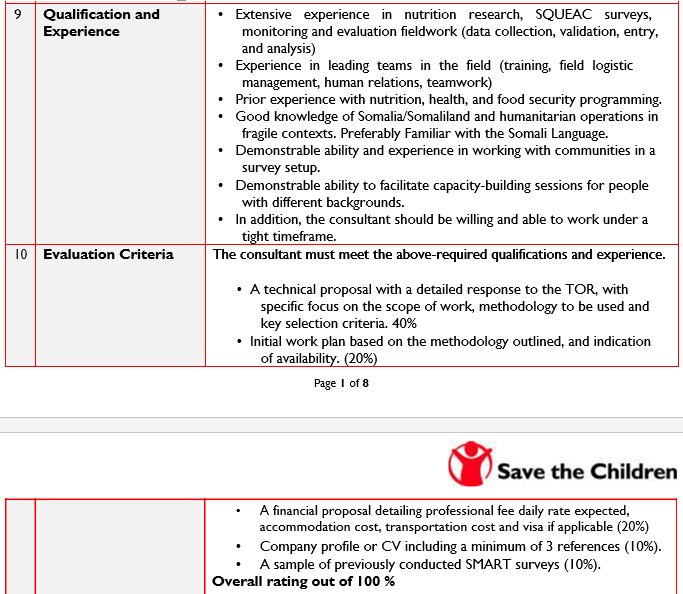
How to apply
Interested consultants should submit their applications via email to [email protected]
The applications should be submitted in PDF format as one document comprising Technical and Financial sections as detailed below.
Proposals for this consultancy should include the following information (at a minimum)
• Proposed approaches – this should clearly elaborate the methodology and logistics required.
• Proposed timelines for each sub-activity
• Proposed budget.
• Curriculum Vitae person intending to lead this investigation.
• Individual/Company Profile – Showing clear experience in facilitating SQUEAC and Coverage surveys. Preferably, include justification that you completed previous assignments with other agencies.
Applicants should also indicate the date they are available to start working on the consultancy.
All applications MUST be submitted on or before the closing date below to be considered for the assignment.
Only shortlisted Candidates will be contacted.
Interested applications should send the specified documents to the following email address.
Location: The consultancy will take place in Beledweyne District.
Supplier Sustainability Policy and the included mandatory policies: Click Here to Access
HOW TO APPLY:
Applications can be submitted by either:
Electronic Submission via ProSave (Recommended)
➢ Submit your response in accordance with the guidance provided in the below document:
• Bidders are encouraged to apply via Ariba system. Please request the Ariba link via email sending your company profile and Business registration certificate/CV. Please address your request to apply via ProSave to [email protected]
Electronic Submission via Protected Email box (Optional)
• Email should be addressed to [email protected]