
 Facebook
 Twitter(X)
 LinkedIn
 Whatsapp
 Telegram
Job description
Terms of Reference
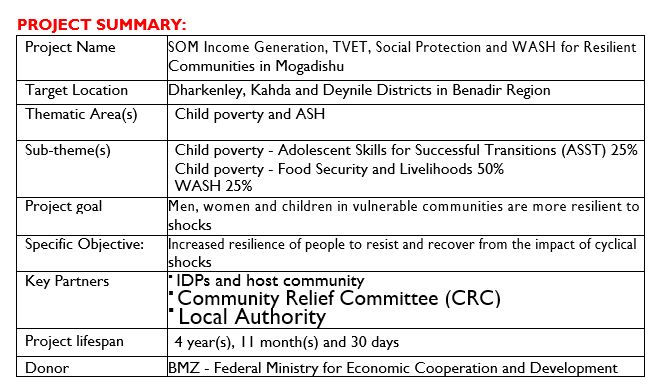
Final evaluation for SOM Income Generation, TVET, Social Protection and WASH for Resilient Communities in Mogadishu
Project SOF: 27600176
Save the Children Somalia
- BACKGROUND:
Save the Children has been working in Somalia/Somaliland for over 40 years. Save the Children Somalia/Somaliland country office is implementing an integrated humanitarian assistance to vulnerable populations in Shebelle IDP camp in Mogadishu through provision of lifesaving health, nutrition, WASH and FSL interventions to the continued humanitarian needs of a population that has been through one of the world’s worst humanitarian crises. The needs of IDPs are multi-dimensional and inter-related. An integrated approach aims to ensure the complex and inter-related needs are met with the most efficient use of resources, whilst addressing the underlying causes of vulnerability, in order to achieve the greatest impact.
Save the children is currently implementing BMZ funded project in Daynile and Kahda. The aims to build the resilience of the most vulnerable households in Deynile and Kahda districts, prioritizing internally displaced persons (IDPs) (both existing and newly displaced), as well as returnee households . The project started in September 2017, progress towards achieving key milestones was made except for some challenges in the initial two months of implementation.
The goal of the project was to the promotion of alternative income-generating opportunities for vulnerable groups; improved access to market-driven technical skills building for young men and women; strengthening social protection for vulnerable populations, and improved access to and sustainability of WASH systems and structures. These goals were to contribute towards the reduction of food insecurity, hunger, and malnutrition, as well as associated diseases and promote long-term resilience.
To ensure the above-mentioned goals the project was intended to build the resilience of the most vulnerable households in Mogadishu, prioritizing IDPs (both existing and newly displaced), as well as returnee households, from Dadaab. In order to minimize conflict between IDP/returnee and host communities, beneficiaries were 80% from the IDP/returnee population and 20% from the host community.
Key target groups for the project include:
The central purpose of the project is to improve household incomes through employment or self-employment. The project has three broad results, Result-1 (R1) which is aimed at supporting women and men through entrepreneurship training and access to business capital ease entry into income generation; R2 which is aimed at supporting young men and women to gain practical skills through TVET programs. Entry criteria to TVET training include (age bracket 18 -29 tears of age; vulnerability drought affected, marginalized minority groups; IDPs; migrant ex pastoralists; ex-militia reintegration; orphans and ex-street children; upper primary for certificate; secondary for diploma; poverty levels; literacy; gender skills set balancing; good behavior background check etc) and R-3 is aimed at providing grants (cash) as safety nets to poor households who qualify for long term government safety net schemes.
The safety nets target poor IDPs who qualify for longer-term government-led safety net schemes. The safety net was implemented as a child grant aimed at improving the welfare of the most vulnerable children in poor households. As a result, it was a requirement for the targeted poor households to have children, preferably below 10 years. Priority was given to the following groups: child-headed households without other forms of support; households headed by disabled persons or elderly persons without support; poor female-headed households; poor households with children admitted to nutrition programs, and poor pregnant and lactating women who are at increased risk of malnutrition.
This was further complemented by improved living conditions and well-being of the target groups through improved access to and sustainability of water, sanitation, and hygiene infrastructures in the IDP camps. the most vulnerable communities and households in the targeted IDP camps benefited from the WASH initiatives under Result 4 particularly women and children who were typically responsible for water collection and the group most at risk of GBV when accessing WASH facilities.
In addition to these direct beneficiaries, the other target groups include:
In order to strengthen the sustainability of this project in the long term, the government was supposed to play an intrinsic role, both as a direct beneficiary through capacity building and system strengthening initiatives, as well as through consultations in the identification of priority areas, ongoing monitoring, supervision, and in the dissemination and uptake of learning to inform wider policy and practice. Key government ministries that were supposed to be engaged in the project include the Ministry of Education & Higher Studies (MOEHS), the Ministry of Labour (MOL), the ministry of planning, the ministry of social services, and the ministry of energy and water.
TVET Centres were also supposed to be supported through MOEHS to develop a Competency-based curriculum, initiate production units for cost recovery and mainstreaming employment promotion services to ensure teaching of entrepreneurship, life skills, internships, linkages with the private sector, and job placement. Aged
Instructors’ refreshers on pedagogy and craftsmanship on new technology were aimed to be supported while young TVET graduates with the right aptitudes and progression potential were supposed to be recruited and trained further in TVET and TOTs in collaboration with other projects.
The project also intended to support the private sector to expand the employment base of the graduates. Strategies include participative approaches with other stakeholders to carry out market systems development which contributes to SME’s sectoral linkages and growth, Business development services (BDS), and product quality and marketing. This was meant to be done through private sector-driven business credit as well as participation in training programs.
- GENERAL OBJECTIVE OF THE EVALUATION:
The purpose of this evaluation is to assess the performance of the project and capture project achievements against the pre-set objectives, challenges, and best practices to inform future similar programming. The project will be evaluated using the OECD DAC criteria which assesses the relevance, effectiveness efficiency, sustainably, impactful, well-coordinated, and gender-sensitive of the project).
Specific Objectives
- To evaluate the project’s performance and achievements vis-à-vis the project’s overall objectives, project indicators in the logical framework, and the baseline data for the indicators gathered at the start of the project.
- To evaluate the relevance, effectiveness, efficiency, impact, sustainability, coordination, scalability/replicability, and gender effects of the project.
- Collect qualitative and quantitative data on the impact of the program including benefits of IGA, TVET/Employment for youth and VSLA, Revolving fund, Social safety net, and integration sectors including health, WASH interventions, and collect case studies that demonstrate change in the lives of children.
- Recommend improvements for the longer-term resilience intervention strategy for the same or similar intervention areas and/or communities
- To document the unintended impact of the project (negative and positive impacts).
KEY QUESTIONS
The following key questions will be explored at a minimum during the evaluation:
Relevance
- To what extent did the intervention objectives consistent with the needs and interests of the beneficiaries?
- Are the activities and outputs of the program consistent with the overall goal and the attainment of its objectives? And to what extent?
- Was the design of the project the most appropriate and relevant to the program approach and strategy?;
Effectiveness
- To what extent did the project attain its objectives and results described in the project proposal?
- What good practices, success stories, lessons learnt and replicable experiences or strategies have been identified in the project implementation which have proven to be effective for replication/scale-up?
- What were the major underlying factors (internal and external) influencing the achievement or non-achievement of the results within the project implementation?
Efficiency
- Did the project use the financial and human resources as per the project document to deliver the intended results?
- Did the project offer better value for money considering its impact on the lives of vulnerable children?
- Were the necessary and adequate resources (financial, human etc) available for running all of the activities?
Impact
-
- To what extent did the project have an impact on the targeted beneficiaries?
- What are the key short-term and long-term changes produced by the project, positive or negative and what are the key factors behind these changes?
- Document the impact of the project in the form of stories/case studies
Sustainability
- Which mechanisms already existed and which have been put in place by the project to ensure results and impact, policy coordination mechanisms, partnerships, and networks are sustainable beyond the project period?
- To what extent has the capacity of beneficiaries (institutional and/or individual) been strengthened such that they are resilient to external shocks and/or do not need support in the long term?
- To what extent will the project be replicated or scaled up at local or national levels?
- What were the major factors which influenced the achievement or non-achievement of sustainability of the project?
Coherence
- To what extent does this project coherent with other similar interventions carried out in the target districts either by SC.
- To what extent does the project compatible with other interventions which have similar objectives implemented by other NGOs, INGOs, and UN agencies in the target locations?
- To what extent does the project coherent with the line ministry’s plans and policies?
Coordination
- How have the project activities been coordinated within different stakeholders including the Government Line Ministries, project committees and other organizations (LNGOS, INGOS, UN) in the target area to achieve overall objective?
Gender equality
- To what extent has the project been gender-sensitive or transformative in design and implementation as per SCI Gender Equality Guidance?
- What concrete measures were taken in the project to increase gender equality and reduce inequalities?
Integration
- Assess the extent of the integrated approach adopted by the project achieved the intended objectives of the project?
METHODOLOGY
The final evaluation will employ a mixed-method outcome-based evaluation, looking both at the intended and unintended impacts of interventions in the Deynile, Kahda, and Dharkeynley districts in the Benadir region. As a result, the evaluation will use a mix of qualitative and quantitative.
The methods to be used for the final evaluation will be participatory to make the activity a positive learning process. The consultant will work with the advice and directions of the Save the Children technical team. Girls and boys will be consulted by using child-friendly and gender-sensitive methodologies; special attention needs will be put in ensuring that boys, girls, women, and people with disabilities (both adults and children) will be able to participate. Everybody's participation will be voluntary, meaningful, safe, and inclusive.
The primary data and data analysis process will be disaggregated by sex, gender, age and disability.
Draft findings will be presented to the project team and key partners to validate.
The evaluation will have the following key phases:
Phase I - Desk study: Review of documentation and elaboration of field Study
The lead consultant/evaluation team will review relevant documents from section 6 below (Reference material). Based on this review, they will produce an inception report which will include an elaborate plan of the evaluation that will include but not limited to study, methodology, and sampling strategy of the data collection plans etc. The evaluation will only proceed to the next stage upon approval of the inception report. An appropriate inception report format will be provided to the selected consultant.
Phase II: Field Data Collection
This phase of the evaluation will seek to collect primary data on the key evaluation questions explained under the evaluation criteria. The consultant will use the agreed plan, methodology, tools and sampling strategies from phase 1 to conduct the fieldwork.
Phase III – Data analysis and production of evaluation report
The team will draw out key issues in relation to evaluation questions and produce a comprehensive report.
As a minimum, the evaluation process will include the following key steps:
- Review of relevant literature related to the project (list of reference materials provided below) and draft an inception report before the evaluation exercise in the field.
- Application of appropriate data collection tools (e.g. questionnaire, checklist, etc.) for interviews and focus group discussion;
- Data analysis and Evaluation Report writing; and
- Presentation of key evaluation findings;
- REFERENCE MATERIALS
Project narrative proposal Baseline Report
Project monitoring and evaluation plan Monthly Reports
Project MEAL reports
Social protection policy developed of Federal government of Somalia. Comparative study Report of tracing study on TVET center graduators
- PROFILE REQUIRED
- Experience in social science or development studies; specifically experience and skills in cash transfer programming, economic empowerment/resilience, and WASH is required. In addition, experience in gender equality mainstreaming, disability inclusion, and research with children by using child-friendly methodologies need to be demonstrated. Experience in the Somalia context is desirable.
- Prior experience in conducting cash-based programming, TVET/employment-related assessments, child protection assessments, and evaluations. Having conducted a similar assignment in Somalia will be an advantage.
- Solid analytical, result-based planning, report writing, communication, and diplomacy skills with the ability to correlate different data sets to actionable conclusions.
- English language skills (report should be written in English). Ability to make clear presentations and disseminate findings to both technical and non-technical audiences.
- OUTPUT AND DELIVERABLES
The following specific outputs are expected –
- An Inception report, produced by within a week after signing the contract.
- A draft evaluation report is produced.
A Final evaluation report including two to three case studies that demonstrate change in the lives of children and recommendations for the Country Programme for future
use of the project design and/or alternative solutions to achieve the same objectives.
- A set of pictures with GPS coordinates taken during the monitoring exercise shall be
appended separately. Pictures must show supported facilities, beneficiaries receiving services, SC branding and all other information that depicts the quality of services.
- Data sets (SPSS, Excel, Stata – for all collected data (quantitative and qualitative). Qualitative data should be transcribed for future use by Save the Children Country Programmes. The data sets should be in an appropriate format (SPSS, Excel, STATA do-
file, and Word) and will be submitted together with the final evaluation report. PowerPoint presentation, summarizing the key findings from the evaluation submitted together with the final evaluation report.
- SAVE THE CHILDREN ROLE
Save the children will provide the following support to the successful consultancy firm/individuals:
- Project documents including a detailed project implementation plan.
- Provision of target areas and beneficiary lists.
- Provision of distribution plans and beneficiary lists.
- Link the Consultant to the relevant stakeholders.
- Other relevant documents.
- COPYRIGHT AND INTELLECTUAL PROPERTY RIGHTS
The title rights, copyrights and all other rights of whatever nature in any materials used or generated under the provisions of this consultancy will exclusively be vested with Save the Children Somalia Country office. All products developed under this consultancy belong to the Save the Children exclusively, guided by the rules of the grant contract. Under no circumstances will the consultant use the information of this study for publication or dissemination to any individual or organization without official prior written permission from Save the Children Somalia Country office.
Skills and qualifications
Technical criteria
Technical proposal on how the assignment will be conducted including methodologies, data analyses and interpretation, reports and schedules, including software to be used for analysis (30%)
Experience in social science or development studies; specifically experience and skills in cash transfer programming, economic empowerment/resilience, and WASH is required. In addition, experience in gender equality mainstreaming, disability inclusion and research with children by using child -friendly methodologies need to be demonstrated. Experience in Somalia context is desirable. Prior experience in conducting cash - based programming, TVET/employment assessments, child protection assessments, and evaluations. Having conducted a similar assignment in Somalia will be an advantage (15%)
Consultancies performed in the last 5 years, especially with reference letters for each (WASH, Cash programming, TVET, and integrated program-related evaluation) 30%.
Company profile and understanding of the TOR. (15%) work plan and reporting (10%) Overall rating out of 100 %
- TIMEFRAME AND ACTIVITIES
The evaluation should be completed over a period of approximately 45 days from the date that the contract is signed. A detailed timetable for the evaluation is illustrated below.
- ETHICS AND CHILD SAFEGUARDING
The consultant is obliged to conduct the research in an ethical manner making sure children are safe at all times. The consultant should seek the views of various stakeholders, including children. Efforts should be made to make the research process child-centered and sensitive to gender and inclusion. The consultant must respect the rights and dignity of participants as well as comply with relevant ethical standards and SC’s Child Safeguarding Policy and Code of Conduct. The research must ensure a voluntary, safe and non-discriminatory participation and a process of free and un-coerced consent. Informed consent of each person (including children) participating in data collection should be documented.
A contract will be signed by the consultant before commencement of the action. The contract will detail terms and conditions of service, aspects on inputs and deliverables.
Attachments
How to apply
Candidates interested in the position are expected to provide the following documentation:
A technical proposal with a detailed response to the TOR, with specific focus on the scope of work, methodology and timelines, and how the participation of children and persons and children with disabilities in the evaluation will be ensured.
Initial work plan and indication of availability.
A financial proposal detailing the daily rate expected including accommodation, transportation, stationary, data collectors, research assistances and all other cost related to this assignment. (Operational and consultancy fees).
Company profile or CV including a minimum of 3 references. At least two previously conducted similar studies.
Application Submission address: indicating “SOM Income Generation, TVET, Social Protection and WASH for Resilient Communities in Mogadishu, Somalia” as the subject. Deadline for submission is August 2, 2022.
Connected and invited consultants should be submitted their document through ProSave. Connected but not invited consultants should be requested to invite and submit their
documents into ProSave.
Unconnected consultants should be sent by to [email protected]
..................................................
NAGUSOO BIIR --- SOMALI JOBS
Telegram: https://t.me/somalijobsinc
Linkedin: https://www.linkedin.com/company/somali-jobs/
Facebook: https://www.facebook.com/somalijobs
Facebook Group: https://www.facebook.com/groups/somalijobs
Twitter: https://twitter.com/somalijobs
Instagram: https://www.instagram.com/somalijobs/
Application: https://play.google.com/store/apps/details?id=com.tiriig.somalijobs
.................................................