
Job details
Posted Date
Mar, 15
Expire Date
Mar, 22
Category
Development
Location
Somalia
Type
Consultant
Salary
---
Education
Masters
Experience
Unspecified
Job description
Terms of Reference (TOR)
DEVELOPMENT OF SLI FRAMEWORK IN SOMALIA.
- Introduction:
Project/Program Title: Resilience Learning Activity – Somalia
Background program overview.
The Resilience Learning Activity Somalia (RLA-S) is a USAID-funded collaborative platform that formed the Somali Resilience Partnership (SRP) as a secretariat and evidence-based entity that fosters collaboration and co-creation between implementing partners of USAID and other donors e.g. Foreign Commonwealth Development Organization (FCDO) and Swiss Development Cooperation (SDC). The coordination between these donors is used to inform and leverage resilience and humanitarian activities by applying USAID’s collaboration, learning, and adapting (CLA) principles together, with an emphasis on providing opportunities at a granular level using sequencing, layering, and integration (SLI) approaches for implementation.
Mercy Corps leads the implementation in Somalia of the ACDI/VOCA-led regional and country levels Resilience Learning Activity (RLA). Somalia Resilience Platform (SRP) platform is part of the USAID regional Resilience Learning Activity (RLA) program in the HoRN of Africa which provides a platform for sharing practices and coordinating actions between actors, including the sequencing, layering, and integration (SLI) of humanitarian and development activities.
The Horn of Africa Resilience Network (HoRN) supports USAID’s objective of strengthening regional and cross-national collaboration and improving evidence-based resilience programming; to end extreme poverty and promote resilient, democratic societies that feature broad-based economic growth, healthy, well-nourished, and educated populations, and environmental sustainability. In this regard, the SRP also acts as a vertical coordination mechanism, linking implementing partners to the USAID Somalia Mission, the Somalia Government, and major private enterprises. Running from 2019 to 2024, RLA currently is at the end of its third year of implementation, and Mercy Corps has been requested to support developing a contextualized framework and pilot for practical sequencing, layering, and integration of critical interventions in strategic sectors to support resilience building and creating meaningful collective impact.
- Objective and Purpose:
- Mainly under RLA’s Objective 1 and the Intermediate Result 1.2 (Joint action plans to address community resilience priorities developed and implemented) and 1.3 (Enhance learning on the effectiveness of SLI & CLA through targeted research and partner reflections), this TOR details areas of engagement to accompany the RLA team in defining the vision for such SLI efforts, including defining how this vision “works” for distinct phases of Somalia’s protracted crisis; the geographic area to be targeted first, and the intervention sectors where it is critical to building community resilience to the major shocks and stresses they face. This effort will help to implement partners in Somalia to point out what SLI means in this context — both as an operational principle as well as programmatic models or key intervention packages that are critical for resilience building in the CDCS target zone — and how it could be carried out.
Specific objective.
- In pursuit of this purpose, the RLA team will conduct an assessment to gauge what “sequencing-layering-integrating” programs and activities mean for partners in supporting resilience, in theory, and in practice in the context studied. This assessment will also help shape a pilot, based on RLA partners’ needs and aspirations in that space.
- General Approach and Methodology of the SLI Framework.
- Brief Literature Review
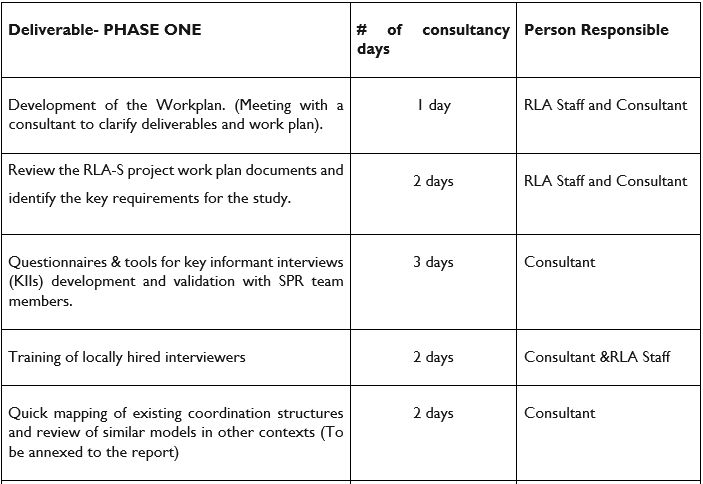
A background review of relevant secondary source materials will be conducted prior to developing the assessment questionnaires. This will include a mapping of humanitarian, development, and peace actor coordination architecture in other contexts to inform the Phase 2 pilot.
- Data collection
- Mapping of actors/partners in the targeted area (from the below list-iii)
- Local interviewers to be recruited by the selected firm/individual.
- Training of interviewers (remote) by SLI Assessment Technical Support team.
- Based on actors mapping, the assessment calendar to be developed and updated.
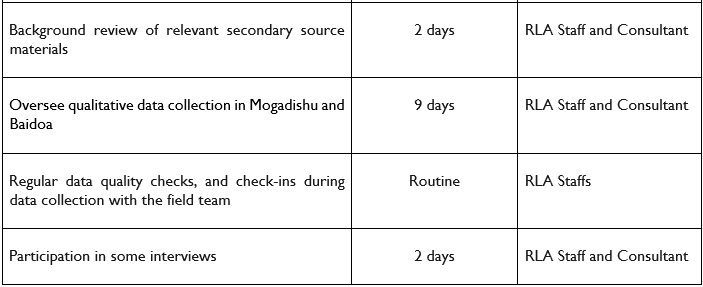
- Data collection (Key Informant Interviews) conducted by interviewers with regular check-ins from the team.
- A total of approximately 20 KII should be conducted. Actors to be included in the assessment for interviews are:
- Target KIIs participants in the SRP Platform:
- International Actors in Baidoa & Mogadishu.
- Humanitarian aid INGOs (we will pick the above lists of the SRP)
- Consortia platforms:
- Peacebuilding INGOs /actors.
- Existing coordination platforms (members and leads) and clusters.
- OCHA-led clusters:
- UN Agencies:
- Nation organizations in the targeted area – Baidoa/ Mogadishu
- Local authorities and institutions in the targeted areas.
- Data analysis.
- Interviewers submit key insights from their interviews on provided canvas
- Online meeting to discuss findings and insights
- Recommendations discussed for reporting
EXPECTED DELIVERABLES.
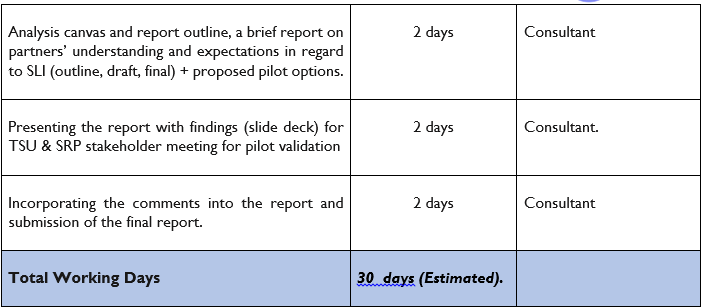
Reporting to:
The selected firm/consult will work closely with the RLA program team leader and will be responsible for the direction and management of this activity.
The Final report is to be completed by 4th May 2023.
Note:
- Ensure full compliance with the data entry protocols, data privacy and protection rules, and the transcripts; the assessment process should respect ethical best practices in terms of obtaining consent from interviewees and respecting their right to privacy.
- The costs related to the arrangements of the workshop will be compensated by the RLA-S project including the booking of the conference rooms, refreshments, and lunch of the SRP partners.
- Any necessary printed materials including brochures to be distributed during the workshop will also be covered by the RLA-S project.
Support from RLA / SRP Team.
To ensure the firm can accomplish the above-mentioned tasks, the RLA team will:
- Share all relevant background documents needed for a desk review and to understand the program which includes the SRP relevant documents. (Learning questions, learning plans etc), SRP Annual Outcome Survey reports and project output reports.
- Provide input to all tool designs.
- Provide feedback to draft report.
- Respond to any issues or concerns from the consultant arising from this activity.
- Stakeholders’ linkage and facilitation support (where necessary)
Eligibility Criteria: -
- Valid Business registration from federal or both states (Banadir & Southwest)
- Company profile-Maximum 5 pages
Required Qualifications
- Contractor’s personnel (i.e., experts to be mobilized by the Contractor to deliver the Assignment) that have a crucial role in implementing the contract are referred to as key personnel. CVs, copies of diplomas, and relevant certifications of key personnel should be included in the Technical Proposal.
- CVs must list and indicate all the relevant activities for the entire time period mentioned in their CVs as years of experience.
Specific requirements:
- Academic: Excellent academic qualifications, preferably including a master’s degree related to data analysis, Monitoring, evaluation and learning, project planning and design or Environmental disciplines.
- Theoretical knowledge: Sound foundational knowledge of MEL, data analytics, USAID CLA framework, including developing framework and principles, practice, and application. Expands and maintains knowledge in the field through literature.
- Software skills: Advanced knowledge of Data analysis tools such as Microsoft Power BI; advanced knowledge of data collection tools, Microsoft Office including Excel; knowledge of R, STATA, Python, or equivalent statistical software an advantage; knowledge of Adobe Suite, particularly InDesign for reporting.
- Knowledge of the context is required and strong experience conducting qualitative research exercises in support of major development programs – preferably in the sectors of resilience programs – in challenging operational environments, previous experience in Somalia is desirable.
- A strong approach to assuring quality assurance of data collected.
- A strong ethical approach to data collection – while still being able to meet the objectives of the consultancy.
- Knowledge of strategic and operational management of humanitarian operations and proven ability to provide strategic recommendations to key stakeholders.
- Strong analytical skills and ability to synthesize and present findings, draw practical conclusions, make recommendations, and prepare well-written reports on time.
- Demonstrated experience in both quantitative and qualitative data collection and data analysis techniques, especially in emergency operations.
- Experience with evaluating USAID/BHA-funded projects.
- Good interpersonal skills and understanding of cultural sensitivities.
- Readiness to travel to Baidoa /Mogadishu in Somalia and conduct direct standard assessment activities as well as field visits to program sites.
Selection Criteria.
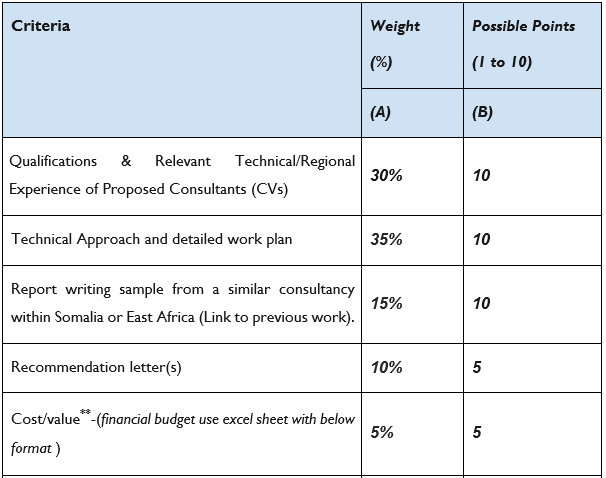
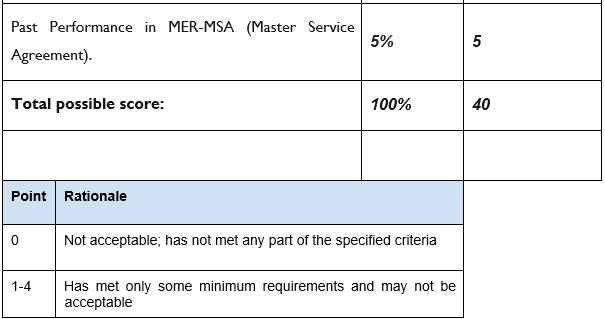
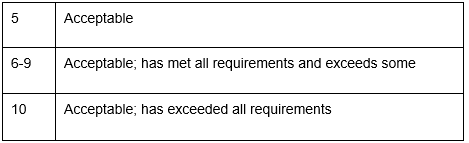
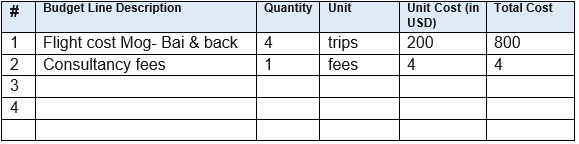
Financial proposal template – Must Use an Excel sheet.
Example:
Payment schedule
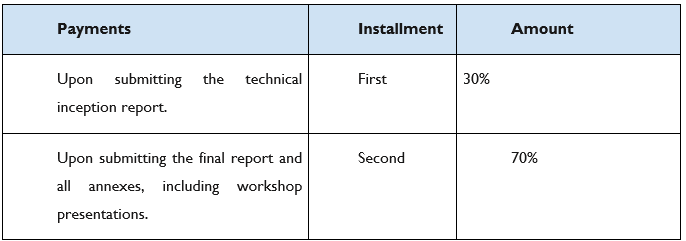
Payments shall be processed in two installments:
- The first installment after submission of the inception report.
- The final payment once the final evaluation deliverables are completed as stipulated in the expected deliverables section above. This will be based on days worked by the consultant as indicated by timesheets submitted alongside invoices.

Skills and qualifications
Eligibility Criteria: -
- Valid Business registration from federal or both states (Banadir & Southwest)
- Company profile-Maximum 5 pages
Required Qualifications
- Contractor’s personnel (i.e., experts to be mobilized by the Contractor to deliver the Assignment) that have a crucial role in implementing the contract are referred to as key personnel. CVs, copies of diplomas, and relevant certifications of key personnel should be included in the Technical Proposal.
- CVs must list and indicate all the relevant activities for the entire time period mentioned in their CVs as years of experience.
Specific requirements:
- Academic: Excellent academic qualifications, preferably including a master’s degree related to data analysis, Monitoring, evaluation and learning, project planning and design or Environmental disciplines.
- Theoretical knowledge: Sound foundational knowledge of MEL, data analytics, USAID CLA framework, including developing framework and principles, practice, and application. Expands and maintains knowledge in the field through literature.
- Software skills: Advanced knowledge of Data analysis tools such as Microsoft Power BI; advanced knowledge of data collection tools, Microsoft Office including Excel; knowledge of R, STATA, Python, or equivalent statistical software an advantage; knowledge of Adobe Suite, particularly InDesign for reporting.
- Knowledge of the context is required and strong experience conducting qualitative research exercises in support of major development programs – preferably in the sectors of resilience programs – in challenging operational environments, previous experience in Somalia is desirable.
- A strong approach to assuring quality assurance of data collected.
- A strong ethical approach to data collection – while still being able to meet the objectives of the consultancy.
- Knowledge of strategic and operational management of humanitarian operations and proven ability to provide strategic recommendations to key stakeholders.
- Strong analytical skills and ability to synthesize and present findings, draw practical conclusions, make recommendations, and prepare well-written reports on time.
- Demonstrated experience in both quantitative and qualitative data collection and data analysis techniques, especially in emergency operations.
- Experience with evaluating USAID/BHA-funded projects.
- Good interpersonal skills and understanding of cultural sensitivities.
- Readiness to travel to Baidoa /Mogadishu in Somalia and conduct direct standard assessment activities as well as field visits to program sites.
How to apply
Consultants/firms that meet the requirements mentioned above are invited to submit a detailed technical proposal and financial proposal as per selection criteria on or before 21st March 2023 and should be addressed to [email protected] referencing ‘Development of
Sequencing Layering Integration (SLI) Framework in Somalia’ in the subject of the email.