
Job details
Posted Date
Nov, 06
Expire Date
Nov, 19
Category
Assessment/evaluation/audit
Location
Somalia
Type
Consultant
Salary
---
Education
Degree
Experience
5 - 6 years
Job description
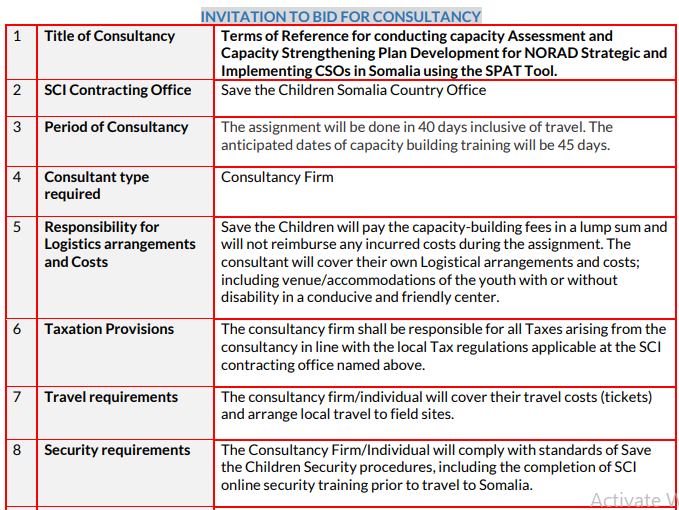
11 INTRODUCTION:
Save the Children International (SCI) is a non-governmental organization whose mission is to fight for children’s rights and deliver immediate and lasting improvement to children’s lives worldwide.
SCI has been operational in Greater Somalia for over 40 years. Current programs straddle relief and development in various sectors including, Health, Nutrition, Child Protection, Child Rights Governance, Vocational and Skills Training, Education and Food Security & Livelihoods (FSL) working in Somaliland, Puntland, and Central South Somalia to help communities cope with drought, conflict, displacement, and flooding.
Save the Children Somalia Country Office commissioned a Child’s Rights Situation Analysis (CRSA) in March 2023 with the aim of understanding the extent of access, availability, acceptability, and quality of relevant social services for Somali children and their families. The CRSA also sought to explore the socio-economic context, power-dynamics, and community norms influencing children’s development potential, including legal and policy gaps. The analysis was conducted across Somalia including Puntland, Galmudug, Hirshabelle, Southwest and Jubaland states, Benadir region and Somaliland. The focus of this phase is that children, especially the most marginalized, learn and develop in an Inclusive, Safe, and Protective Environment. The programme will be implemented in South Central Somalia and Puntland in 11 districts (Beledweyne, Mataban, Abudwak, Gardo, Garowe, Dhusamareb, Bosaso, Iskushuban, Galkayo, Galdogob and Dhobley)) supporting 40 schools, and part of the CRG activities will be implemented in Somaliland. The programme will target 18,600 children (50% girls and 10% children with disabilities).
The programme will address the challenges that were identified in the Child’s Rights Situation
Analysis and employ a nexus approach in education, child protection, child rights governance and climate change, building on evidence and learning from the previous phases. The socio-ecological model has been used to provide a comprehensive understanding of factors, institutions and ideologies influencing the situation of children and how they might be addressed. The proposed interventions are holistic and seek to influence change at different levels: the child; family/home; community systems and services, and community norms; institutions (government and CSOs); and laws and policies. The programme envisions three broad impacts:
1)
The most marginalized children (including girls and children with disabilities) have equitable access to safe, inclusive, and quality learning environments to improve their Literacy and Numeracy skills by 2028.
2) Vulnerable boys and girls including children with disabilities in Somalia are better protected from violence, abuse, exploitation, and neglect.
3) Children’s rights are prioritized and realized by duty-bearers in Somalia.
Engagement of local partners and meaningful participation of children has been ensured so that they have a voice and have influence in decision making that affects them. The programme acknowledges the inequalities faced by children due to gender, disability, marginalization as well as the impact of climate change on children.
Aligned with its 2022-2024 localization strategy, SCI Somalia developed the SPAT (Strategic Partnership Assessment Tool) in partnership with the Somali NGO Consortium and over 25 INGOs. This tool provides a framework for assessing and strengthening the capacity of local partners, empowering national and local actors to lead humanitarian and development efforts effectively. The assignment will target seven local partners from NORAD’s strategic and implementing partners for institutional assessment and the development of comprehensive capacity strengthening plans to support their effectiveness and long-term sustainability.
OBJECTIVES:
The overall objective of this assignment is conducting a comprehensive capacity assessment for strategic and implementing Civil Society Organizations (CSOs) using the SPAT tool, and to develop a tailored capacity strengthening plan that enhances their operational effectiveness and impact. On the other hand, the assignment seeks to leverage on Save’s sectoral expertise to develop Shifting Power ambition to put local and national actors in the driving seat by Supporting local CSOs to establish systems contextualized to local abilities and potential for collaboration among the CSOs and local communities.
Specific Objectives
• Evaluate the existing capacities of selected strategic and implementing CSOs using the SPAT tool to identify strengths and weaknesses in their organizational, programmatic, and operational capabilities.
• Analyze assessment data to identify specific capacity gaps in key areas such as governance, financial management, program delivery, advocacy, and monitoring and evaluation.
• Formulate a comprehensive capacity strengthening plan that addresses identified gaps with tailored strategies and interventions.
• Prepare a final report summarizing assessment findings, the capacity strengthening
plan, and actionable recommendations for CSOs and stakeholders.
This exercise aims to conduct a comprehensive capacity assessment for strategic and implementing Civil Society Organizations (CSOs) using the SPAT through the following activities.
1. Project Inception-Conduct a kick-off meeting with key stakeholders to clarify project objectives, expectations, and timelines and review relevant documentation related to the CSOs and the context within which they operate.
2. Capacity Assessment Using SPAT Tool- Use the SPAT tool to assess the current capacities of selected CSOs. Collect quantitative data through surveys and qualitative data via interviews and focus group discussions.
3. Stakeholder Engagement-Identify and engage key stakeholders, including CSO staff. Facilitate workshops and discussions to gather insights on organizational strengths, challenges, and opportunities.
4. Development of Capacity Strengthening Plan-Collaborate with CSOs to develop a tailored capacity strengthening plan that addresses identified gaps. Define specific strategies and interventions, including capacity-building activities and training programs.
5. Final Report Preparation-Compile a comprehensive final report that includes:
• Assessment findings
• The developed capacity strengthening plan
• Recommendations for ongoing improvement and sustainability
• Present the final report to stakeholders in a validation workshop, gathering feedback for refinement.
PROJECT/ACTIVITY LOCATION
The proposed activities will be conducted in Southern Central States.
METHODOLOGY:
The overall exercise will primarily be a desk study but will contain set of qualitative data collection stages to develop a substantive, user-centered capacity assessment and capacity development exercise. The steps mentioned below will be an integral part in the process.
• Desk Review-Conduct a thorough review of existing documentation related to the CSOs.
• Gap Analysis-Use qualitative and quantitative methods to assess current capabilities and identify gaps.
• Capacity Assessment Tools-Develop and use standardized tool (SPAT TOOL) to evaluate the capacities of local CSOs.
• Interviews and Focus Groups-Conduct KII interviews and focus group discussions with stakeholders/CSOs to collect in-depth information.
• Data Analysis-Analyze data to identify trends, patterns, and areas for improvement.
• Validation meeting Organize a meeting to validate findings and refine recommendations with each partner’s input.
DELIVERABLES:
The consultant will be expected the following deliverables.
• Inception Report-Detailed methodology, work plan, and timeline.
• Capacity Building Report-Findings from the capacity assessment and trainings.
• Recommendations Report-Actionable recommendations for capacity building.
• Final Report-Consolidated report including all findings, analyses, and recommendations.
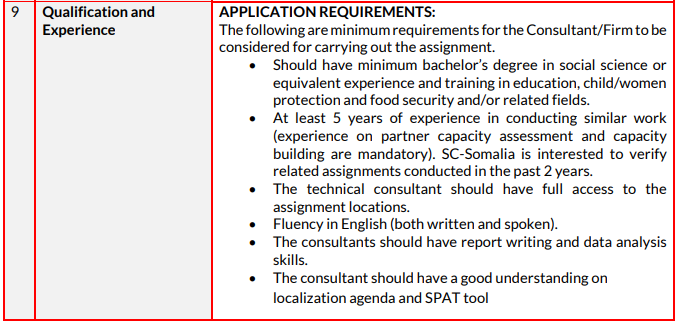
APPLICATION REQUIREMENTS:
The following attributes are requirements for the selection of the innovation hub center.
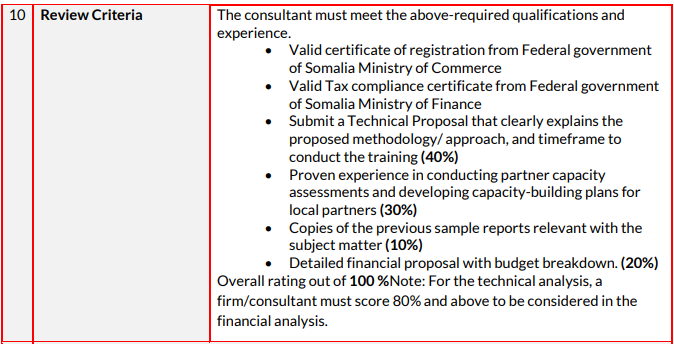
• Proven experience of conducting capacity assessment / capacity building for local CSOs. Please attach copies of previous contracts.
• Copy of registration certificate from the government.
• Submit a Technical Proposal that clearly explains the proposed methodology/ approach, and timeframe to conduct the training.
• Submit detailed financial proposal with cost break down.
• Submit CVs of the lead facilitators conducting the training including relevant qualifications.
CODE OF CONDUCT:
Because Save the Children's work is based on deeply held values and principles, it is essential that our commitment to children's rights and humanitarian principles is supported and demonstrated by all members of staff. Save the Children's Code of Conduct sets out the standards which all staff members must adhere to.
Skills and qualifications
How to apply
Applications can be submitted by either:
Electronic Submission via ProSave (Recommended)
• Submit your response in accordance with the guidance provided in the below document:
• Bidders are encouraged to apply via Ariba system. Please request the Ariba link via email sending your company profile and Business registration certificate/CV. Please address your request to apply via ProSave to [email protected]
Electronic Submission via Protected Email box (Optional)
• Email should be addressed to [email protected]
• Note – this is a sealed tender box which will not be opened until the tender has closed. Therefore, do not send tender related questions to this email address as they will not be answered.
• The subject of the email should be “PR542755“Terms of Reference for conducting capacity Assessment and Capacity Strengthening Plan Development for NORAD Strategic and Implementing CSOs in Somalia using the SPAT Tool’’. – ‘Bidder Name’, ‘Date’’.
• All attached documents should be clearly labelled so it is clear to understand what each file relates to.
• Emails should not exceed 15mb – if the file sizes are large, please split the submission into two emails.
• Do not copy other SCI email addresses into the email when you submit it as this will invalidate your bid
Your bid must be received, no later than 19/11/2024
Bids must remain valid and open for consideration for a period of no less than 60 days