


Job details
Posted Date
Oct, 09
Expire Date
Oct, 22
Category
Consultancies
Location
Somalia
Type
Consultant
Salary
---
Education
Unspecified
Experience
Unspecified
Job description
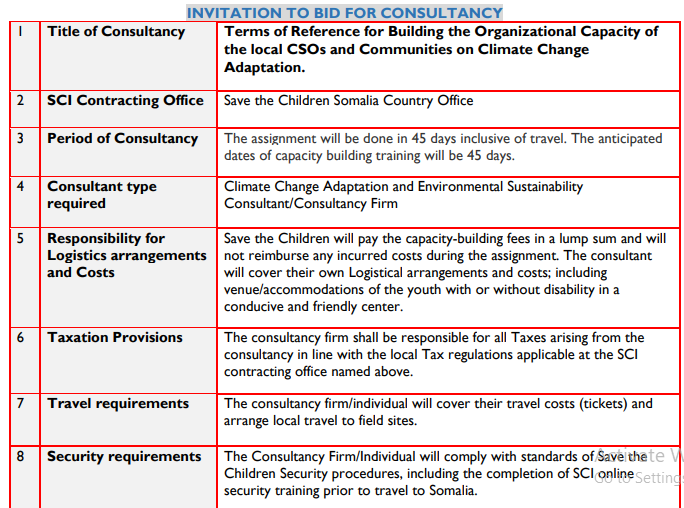
11 INTRODUCTION:
Save the Children has worked in Somalia for over 70 years and is a national and international leader in humanitarian and development programming. Our long operational history and broad geographical coverage, has afforded us positive working relationships with key stakeholders, including the federal government, state and local authorities, donors, international and local NGOs, as well as the trust and acceptance of the communities themselves. Save the Children has operational presence in 17 regions in the country, with over 640 national and international staff across 14 field offices.
Save the Children implements a wide range of multi-sectoral humanitarian and development projects in Somalia. Our programming is guided by our Country Strategic Plan 2022-24 which follows a child life cycle model to make sure our programs consider a child and their needs holistically and respond with thematically integrated and age-appropriate interventions. Our active portfolio in 2023 covers programs in Food Security and Livelihoods, Social Protection, Youth Economic Empowerment, Education, Health, Nutrition, WASH, Child Protection, Child Rights Governance and Advocacy while mainstreaming climate change adaptation across our portfolio. In addition, gender equality and disability inclusion are mainstreamed in all our programs.
BACKGROUND:
Somalia is at the frontline of the climate crisis. Lives and livelihoods in the country are already being disrupted by climatic shocks and stressors. Over the past two decades, climate-related disasters have impacted more than 5 million people across the country. Droughts have affected more people in recent years, while floods are proving more deadly - nearly 50% of the people in Somalia rely on the land to grow their food and generate an income. Although communities feel the full force of the changing climate, they have been under-represented (if not invisible) in discussions of the unfolding global disaster. This is the reality of climate injustice. Climate impacts are also hampering Somalia’s development, including through water shortages, reduced food production, and low economic growth. Climate change is a global issue that affects all sectors of society and requires collective action to address. Civil society organizations (CSOs) play a critical role in advocating for climate justice and ensuring that the needs and rights of vulnerable communities are addressed. However, many CSOs lack the necessary technical and operational capacity and understanding of climate justice and financing issues to effectively engage in this work.
Despite of the great community-based work the CSOs are doing to combat climate change and environmental threats in Somalia, they have not been able to get the necessary attention and access the climate finance to implement their work, innovative technologies, directly engage donors and be part of the decision-making process of the country. Grassroot CSOs understand well the importance of conveying community needs and capacities in climate change discussions, and, hence, have great potential to take up this localization initiative without equally increasing its cost base. Potential for exporting key structural elements of the proposal to other sectors, regions, or committees (replicability) that will transform the environmental, economic, and social conditions of communities
Page 2 of 6
living in the target areas of Somalia. This why it is very important to consider community based locally led adaptation advocacy led by local civil society organizations to be supported and empowered.
OBJECTIVES:
Save the Children Somalia Country Office is seeking an expert consultant/firm to conduct capacity building trainings to realize solutions for the above challenges focused on global trends in climate change adaptation for Somalia Civil Society Organizations advocating for climate change and environmental sustainability so that youth led CSOs can as well conduct awareness raising campaign to sensitize the public on environmental issues through implementation of community-led risk awareness raising and planning and identify strategies suited to their context that they could pursue with this programs support. The trainings are also meant to ensure preservation of resources and address effects of climate change on natural resource-based production during times of shock and stress, and to improve and strengthen their livelihood activities without increasing the risks communities face. The CSOs capacity building is focused on creating an enabling environment for the implementation of
sustainable practices among communities. This initiative has an aim to promote environmental conservation, climate change mitigation, and sustainable development through education. It will involve various stakeholders, including policymakers, educators, students, and parents.
SCOPE OF WORK:
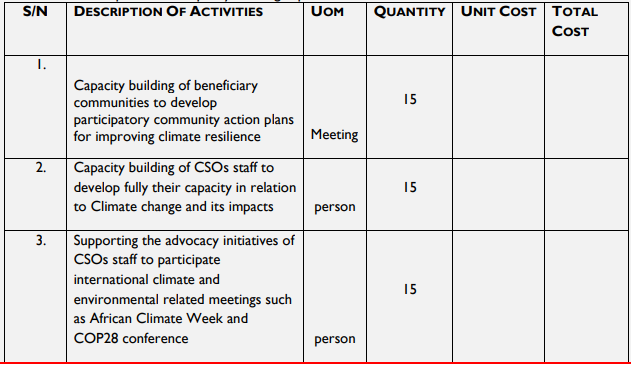
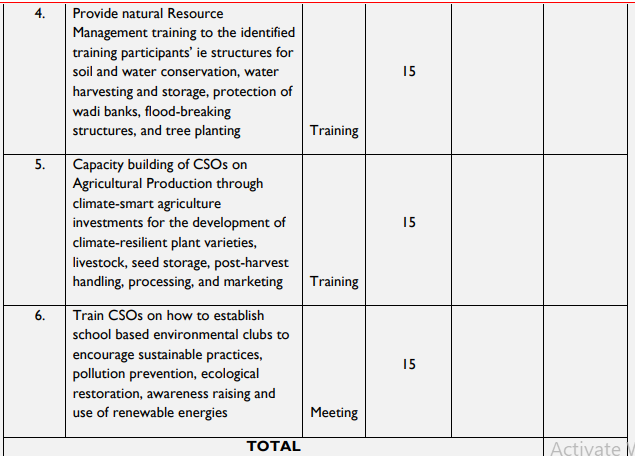
This assignment will focus on training 3 CSOs staff to develop participatory community action plans for improving climate resilience, including collection and documentation of local best experiences and indigenous knowledge on improving climate resilience at the local level, knowledge sharing and exchange in coordination with relevant local and national stakeholders, disaster preparedness and use of early warning information at local level to enhance use of early warning systems for droughts and flood hazards and also capacity building to be able to provide technical advice and training to farmers in support of organizational and managerial capacity building to existing and/or newly formed farmer groups and organizations. Also included are capacity-building activities in support of development and implementation through community mobilization and training of an integrated landscape approach to promote more sustainable management of water and other natural resources. This training will also cover Capacity building of CSOs staff to develop fully their capacity in relation to Climate change and its impacts supporting the advocacy initiatives of CSOs staff to participate international climate and environmental related meetings such as African Climate Week and COP28 conference. The training package will also include basic elements including structures for soil and water conservation, water harvesting and storage, protection of wadi banks, flood-breaking structures, and tree planting and climate-smart agriculture training for the development of climate-resilient plant varieties, livestock, seed storage, post-harvest handling, processing, and marketing.
EXPECTED OUTCOMES:
• Strong network of Somali civil society for climate change advocacy is established.
• Empowered children and youth as future climate and environment champions through the school green initiatives.
• Improved Community integration and collaboration to prevent and mitigate land degradation, deforestation, and displacement.
• Improved innovative soil and water conservation practices for enhanced community-based food
production and reduced climate risks impact on food security at household level.
PROJECT/ACTIVITY LOCATION
The proposed activities will be conducted in Mogadishu and Baidoa respectively.
METHODOLOGY:
The overall training process will be highly experiential and participatory. The discourse approach involves various techniques including but not limited to brainstorming, Interactive Q and A, Group work exercises Case study, Role play and business modeling, pitching exercises.
Specifically, individual consultant/firm will undertake the following key tasks.
Page 3 of 6
• Present an inception training/session plan complete with goals, objectives, topic and subtopics, methodology, session plans, teaching aiding, activities and expected outcomes for each presentation.
• Prepare a training program to include promotion of environmental conservation, climate change mitigation, and sustainable development through education.
• Apply and use the SCI climate factsheet strategic priorities to advance climate change adaptation.
• Deliver the training through participative methodologies.
• Conducting a Strengths, Weaknesses, Opportunities, and Threats (SWOT) analysis of the CSOs organizational capacities.
• Evaluate the Climate Change Adaptation skills and knowledge gaps of the CSOs and provide tailored trainings to each based on the assessment carried on a rolling basis.
• Assessing the economic feasibility/viability of the adaptation idea.
• Recommends the steps and timelines for the climate change adaptation realization.
• Overarching support to youth led CSOs to be pitch deck and promote environmental conservation, climate change mitigation, and sustainable development through education and learning about climate financing and justice.
• Present an inception training/session plan complete with goals, objectives, topic and subtopics, methodology, session plans, teaching aids, activities and expected outcomes for each presentation.
• Administer daily feedback forms and end-of-training evaluations.
• Write a draft and final report –Include follow-up and implementation schedules as per provided report format.
DELIVERABLES:
• Administer daily feedback forms and end-of-training evaluations.
• Write a draft and final report –Include follow-up and implementation schedules as per provided report format.
• Inception training/session plans
• Support developing viable skills on environmental conservation, climate change adaptation, and sustainable development through education and advocacy campaigns.
• A comprehensive capacity building report.
Skills and qualifications
How to apply
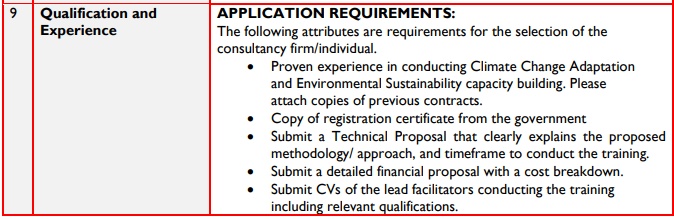
APPLICATION REQUIREMENTS:
The following attributes are requirements for the selection of the innovation hub center.
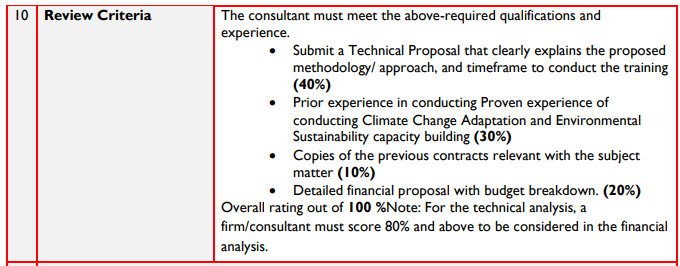
• Proven experience of conducting environmental conservation, climate change adaptation, and sustainable development through trainings. Please attach copies of previous contracts
• Copy of registration certificate from the government
• Submit a Technical Proposal that clearly explains the proposed methodology/ approach, and timeframe to conduct the training.
• Submit detailed financial proposal with cost break down.
• Submit CVs of the lead facilitators conducting the training including relevant qualifications
CODE OF CONDUCT:
Because Save the Children's work is based on deeply held values and principles, it is essential that our commitment to children's rights and humanitarian principles is supported and demonstrated by all members of staff. Save the Children's Code of Conduct sets out the standards which all staff members must adhere to.
Supplier Sustainability Policy and the included mandatory policies: Click Here to Access
HOW TO APPLY:
Applications can be submitted by either:
Electronic Submission via ProSave (Recommended)
➢ Submit your response in accordance with the guidance provided in the below document:
Page 5 of 6
Bidding on a
Sourcing Event.pptx
• Bidders are encouraged to apply via Ariba system. Please request the Ariba link via email sending your company profile and Business registration certificate/CV. Please address your request to apply via ProSave to [email protected]
Electronic Submission via Protected Email box (Optional)
• Email should be addressed to [email protected]
• Note – this is a sealed tender box which will not be opened until the tender has closed. Therefore, do not send tender related questions to this email address as they will not be answered.
• The subject of the email should be “RN373463-Terms of Reference for Building the
Organizational Capacity of the Youth-Led CSOs Focusing on Global Trends in Climate
Change Adaptation’’. – ‘Bidder Name’, ‘Date’’.
• All attached documents should be clearly labelled so it is clear to understand what each file relates to.
• Emails should not exceed 15mb – if the file sizes are large, please split the submission into two emails.
• Do not copy other SCI email addresses into the email when you submit it as this will invalidate your bid.
Your bid must be received, no later than 22nd October 2023
Bids must remain valid and open for consideration for a period of no less than 60 days