

Job details
Posted Date
Aug, 27
Expire Date
Sep, 09
Category
Monitoring And Evaluation
Location
Somalia
Type
Consultant
Salary
---
Education
Degree
Experience
5 - 6 years
Job description

- BACKGROUND
1.1. CONTEXT BACKGROUND:
Somalia is one of the most complex and long-standing humanitarian crises in the world, driven by coexisting armed conflict, violence, and recurrent climactic shocks that perpetuate the situation and exacerbate persistent poverty. Additionally, the country faces an unprecedented crisis and funding gap related to the critical drought situation following three consecutive below-average rainy seasons. At the onset of this phase of this project in June 2022, more than 4.6 million people in 66 out of the country’s 74 districts were experiencing the cumulative impacts of three consecutive below-average rainy seasons. As of December 2022, 1,007,297 people had been displaced in search of water, food, and pasture.1 The consecutive 2021/2022 failed seasons suppressed critical food and income sources of vulnerable pastoral and agro pastoral households through mid-late 2022. The cereal crop production in Southern Somalia, which is the food basket of the country had dropped by 60% of the expected long-term average. The 2022 Deyr season was the third consecutive below-average rainfall season since late 2020, leading to one of the worst Deyr harvests on record. In addition, the drought led to massive livestock losses and exceptionally high cereal prices. Due to this, FSNAU anticipated that 6.9 million people were expected to face Crisis (IPC Phase 3) or worse acute food insecurity outcomes between April and June 2023.4 Despite the ongoing delivery of humanitarian food assistance, levels of acute food insecurity across Somalia remain high, with approximately 5 million people already experiencing Crisis or worse (IPC Phase 3 or higher) outcomes between January and March 2023, including 1.4 million in Emergency (IPC Phase 4) and 96 000 people in Catastrophe (IPC Phase 5). All these are happening when coping capacities and social support systems of the most affected populations has already been stretched beyond their limits due to the increasing food prices which are also driven by global factors such as the Ukraine crisis and local factors like conflict and inflation in some of the areas. In its attempt to mitigate the situation, the federal government of Somalia declared a national state of emergency on November 23rd, 2021, due to the severity of the drought and again on 13th January 2022 including an appeal for urgent humanitarian assistance. High levels of acute malnutrition continue to persist in most parts of the country, driven by chronic health and WASH factors and exacerbated by reduced food and milk intake and disease outbreaks. Based on the results of 31 nutrition surveys conducted by the Food Security and Nutrition Analysis Unit (FSNAU) and partners between October and December 2022, the total estimated acute malnutrition burden for Somalia from January to December 2023 was approximately 1.8 million children, including 477,700 children who were likely to be severely malnourished. At the national level, the prevalence of acute malnutrition during 2022 Deyr showed some improvement compared to 2022 Gu. Median prevalence of Global Acute Malnutrition (GAM) was 15.4% in 2022 Deyr compared to 15.9% in 2022 Gu. However, 2022 Deyr GAM prevalence was worse than in 2021 Deyr (Serious, 14%). Compared to 2022 Gu, a significant decline in GAM prevalence was noted among Baidoa IDPs (28.6 % to 21.2 %), Baidoa& Burhakaba AP (24.9 % to 19.8 %) and Galkacyo IDPs (20.6 % to 15.4 %). Severe Acute Malnutrition (SAM) prevalence has also decreased among Baidoa IDPs (10.2% to 5.9%) over the same period.
1.2. BHA Integrated project
Save the Children International, Somalia programme initiated an integrated project titled Sustainable Opportunities for more Accessible Livelihoods and Integrated Assistance in June 2022. The goal of the 10- month programme implemented in Somalia and Somaliland was: To save lives, alleviate suffering, maintain human dignity, and build resilience in communities experiencing humanitarian crisis and/or are food insecure. The goal of the programme is underpinned of Theory of Change (ToC) which states that: If the most crisis-affected populations in Somalia can access inclusive, localized, integrated, multi-sectoral support, including health, nutrition, WASH, food security and livelihoods and protection services to meet their immediate lifesaving needs, then suffering will be alleviated, and lives saved; Human dignity will be maintained and the long-term resilience of communities experiencing climate shocks and humanitarian crisis will be built. To achieve the desired change, SCI implemented activities across the following sectors: Health: Activities towards this was aimed at increasing access to inclusive and comprehensive quality primary healthcare through different levels of health service delivery. Nutrition: This involved support of health facilities and nutrition centres to offer targeted treatment of SAM for children under the age five and treatment of Moderate Acute Malnutrition (MAM) for both children and five and Pregnant and Breastfeeding Women (PBW). WASH: This involved development of water supply infrastructure, provision of water through water trucking, and construction of latrines in both community and health facilities; solid waste management, distribution of WASH NFI items and hygiene promotion campaigns. Food assistance: This activity involved Unconditional Cash Transfer (UCT) to enable vulnerable households’ purchase food. Protection: This support involved community-based protection mechanisms, Chile Protection (CP) case management, and Psycho-Social Support (PSS) integrated into a holistic protection intervention
Program Goal: To save lives, alleviate suffering, maintain human dignity, and build resilience in communities experiencing humanitarian crisis and/or are food insecure.
1.3. PROJECT LOCATIONS
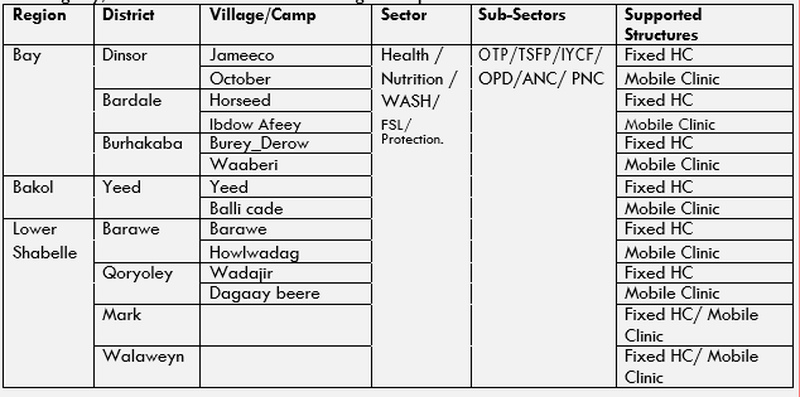
Save the Children continued support of the 12 health and nutrition facilities across different regions including Bay, Bakool and lower Shabelle through local partners called GREDO as shown below:
2. GENERAL OBJECTIVE
The overall objective of third-party monitoring is to assess and provide detailed analysis of achievements against the anticipated project target and measure the up-to-date performance of the project. The third-party monitoring evaluation is to facilitate a process which will document project outputs and measure progress achieved. The project covers sectors in health and nutrition, water supply, hygiene, and
sanitation, and food security and recommends/suggest actions deemed fit for enhancing the efficiency and effectiveness of the projects’ activities.
Therefore, to improve the accountability of the program, and quality of project delivery, a third-party monitor will be contracted to monitor the project progress and also to ensure whether the project implementation is in line with SCI accountability strategy.
2.1. SPECIFIC OBJECTIVES
- To assess the project’s performance and achievements vis-à-vis the project output level indicators in the logical framework, and the baseline data for the indicators gathered at the start of the project.
- To assess and cross-check how program quality is being implemented according to SCI benchmarks and standard and accountability system that is currently in place.
- Collect qualitative data on the benefits of combining the food assistance support activities and other integration sectors including health, nutrition, and WASH interventions, and collect case studies that demonstrate change in the lives of children.
- To cross check programme monitoring documents in the health and nutrition sites and check the smooth running of operations, in addition to that check supply chain system - check in the warehouses or stores - dispensaries, and how the supplies are documented.
- Cross-check admissions and discharge trends of the IMAM programs as well health data - per site to cross-check the data we have Vis Visa the real data on the registers and cards
- Collect qualitative data on the output level program including benefits of combining the IGA and VSLA support activities and other integration sectors including health, nutrition, and WASH interventions, and collect case studies that demonstrate change in the lives of children.
- Evaluate the accountability of the response to the affected population.
- To document the unintended impact of the project (negative and positive impacts).
- cross-check how SBCC or socially behavioural, changing communications (nutrition, health and hygiene promotion sessions, IYCF etc) are being delivered in the health and nutrition sites.
- SCOPE OF WORK
The third-party monitoring will specifically provide feedback on the following areas of implementation:
- Beneficiary selection and identification:
- Hold interviews with beneficiaries and non-beneficiaries and other stakeholders to document the beneficiary selection and identification process, specifically community participation, including both women and men, marginalized groups, and persons and children with disabilities (women, men, girls, boys) disaggregating data by sex and by persons/children with disabilities in the selection and verification of beneficiaries.
- Document the process of identifying and selecting beneficiaries and committees and the role of the committee members (disaggregating data by sex and by persons with disabilities) and SCI and Partner staff in the selection and verification of project beneficiaries.
- Assess the appropriateness of the targeting criteria, the extent to which it was followed, and the overall fairness of the process and check how the triage system is followed - that means most severe or illness cases are first-served or supported or admitted in the programme rather than keeping all beneficiaries on the que.
- Identify if there were any shortcomings in the process, e.g., payment or diversion of assistance. Diversion of cash through voluntary or involuntary taxation or forced contribution should be properly scrutinized and reported.
- Determine how the targeted communities, i.e., boys, girls, women, men, marginalized groups, and persons with disabilities have benefited from the unconditional cash transfers, health, nutrition, and WASH interventions in their respective communities (focus on beneficiary selection and if it has been inclusive and transparent).
- Determine and assess whether our programmes are integrated or standalone ones and cross-check if there is linkage between different thematic areas that the BHA is supporting.
- Mobile cash transfer system:
- Determine how targeted project beneficiaries have benefited from the mobile cash transfer system in which they’ve received their unconditional cash transfer.
- Gather general feedback from project beneficiaries between the advantages and disadvantages of using a mobile cash transfer delivery system.
- Information sharing:
- Assess the extent in which the beneficiaries, including girls and boys, women, men, persons with disabilities, children with disabilities, and other marginalized groups, are informed and aware of key project information, such as project objectives, activities, timelines, entitlement, number of cash payments, child protection response services, expected results and targeted beneficiaries and criteria for selecting beneficiaries.
- Establish whether beneficiaries, including girls and boys and persons and children with disabilities, have been informed and are aware about opportunities/activities in which they can participate.
- Establish whether there is information that beneficiaries, including girls and boys and persons and children with disabilities, would like to receive about the project and its implementation but which has not been shared.
- Feedback and response mechanisms:
- Establish beneficiaries, including girls and boys and persons and children with disabilities, awareness of mechanisms through which they can give feedback or make complaints to SCI (how to give feedback or raise concerns about activities, what they can complain about, who they can complain to, how and where they can complain, and issues of confidentiality).
- Assess the acceptance and level of confidence that beneficiaries have in the existing SCI feedback and response mechanisms.
- Generate ideas for improving the existing feedback-handling mechanism.
- Assess how SCI and Partner have succeeded in responding to the feedback and complaints received.
- Participation:
- Generate information about how beneficiaries, including girls and boys and persons and children with disabilities, would like to / are participating in the project implementation.
- Collect feedback on how parents/caregivers have been selected to be part of the cash transfer, protection including referral, IYCF, and Health/nutrition facilities, i.e. if the selection was inclusive and transparent., satisfaction on cash beneficiary selection and identification process.
- Quality of program:
- Assess the quality of the activities/services meeting desirable standards including beneficiaries’ opinions with a focus on children on the quality of the delivery service.
- Assess the quality of health facilities including Outpatient consultation, ANC/PNC services, Labor room & Safe delivery procedures, Laboratory, Referral procedures, EPI services SGBV Consultation, and pharmacy in line with minimum SCI quality standards.
- Assess the quality of nutrition services including Community Mobilization and Sensitization (# of CNV and Community Mobiliser) working each site, OTP and TSFP activities, Physical examination and treatment, Health Education, IYCF (Individual and group counseling), distribution of Plumpy Sup, plumpy nuts and (CSB) for PLW
VII. Project results in regard to integration:
- Identify and document evidence of project integration between cash programming, child survival program, and child protection.
- Collect case studies and success stories on unconditional cash transfers.
- Methodology
The consultant will employ a mixed-method approach to assess the quality of service and community satisfaction based on the above indicators and the scope of work in project-targeted areas. The consultant will document both the intended and unintended outcomes of interventions. The consultant will also apply participation during data collection to ensure a positive learning process. The consultant will work with the advice and directions that will be provided by the Save the Children technical team. The consultant will design a sampling approach to adept the data collection. Save the Children is a child-sensitive organization therefore, Girls and boys will be consulted by using child-friendly and gender-sensitive methodologies; special attention needs will be put into ensuring that boys, girls, women, and persons with disabilities (both adults and children) will be able to participate. Everybody's participation will be voluntary, meaningful, safe, and inclusive.
Rather than the above-mentioned methodology the consultant should fully understand the nature of the assignment and propose/develop a compatible data collection methodology and tools based on the project objective and result framework. the consultant should also justify their proposed methodology and explain why he/she/they prefers it.
The primary data and data analysis process will be disaggregated by gender, age, and disability by using Washington Group short-set questionnaire. Draft findings will be presented to the project team and key partners to validate.
- Consultant role and expected deliverables.
The consultant is expected to perform through 3 phases –inception, data collection process, reporting, and dissemination. Some key activities during these phases include an adaptation of some pre-developed tools and the development of some extra research tools, training data collectors, document review, data collection, analysis/interpretation, report writing, and presentation to key stakeholders. The evaluation will have the following key phases:
Phase I - Desk study: Review of documentation and elaboration of field Study
The lead consultant/evaluation team will review relevant documents from section 6 below (Reference material). Based on this review, they will produce an inception report which will include an elaborate plan of the evaluation that will include but not limited to study, methodology, and sampling strategy of the data collection plans etc. The evaluation will only proceed to the next stage upon approval of the inception report. An appropriate inception report format will be provided to the selected consultant.
REFERENCE MATERIALS
- Project narrative proposal and milestone targets
- Project monitoring and evaluation plan
- Monthly and Quarterly Reports
- Project MEAL reports (IPTT)
- Project narrative reports
- Project Baseline report.
- SCI quality benchmark tools.
Phase II: Field Data Collection
This phase of the evaluation will seek to collect primary data on the key questions explained under the scope of work criteria. The consultant will use the agreed plan, methodology, tools, and sampling strategies from Phase 1 to conduct the fieldwork.
Phase III – Data analysis and production of evaluation report
The team will draw out key issues in relation to evaluation questions and produce a comprehensive report.
As a minimum, the evaluation process will include the following key steps:
- Review of relevant literature related to the project (list of reference materials provided below) and draft an inception report before the evaluation exercise in the field.
- Application of appropriate data collection tools (e.g. questionnaire, checklist, etc.) for interviews and focus group discussion
- Data analysis and Evaluation Report writing; and
- Presentation of key evaluation findings
- Dataset, photos, GPS and case studies.
- Reporting
The consultant will maintain daily contact with the SCI team assigned to manage the monitoring activities.
The collected data will be analyzed on daily basis by the consultant and given feedback to the teams.
A final report with main text of a maximum 40 pages excluding the cover page, table of contents, abbreviations, and annexes. The draft report should be delivered in a soft copy in English. References should be fully cited after all important facts and figures. The report should be structured as follows:
- Front page with the title of the report, project and SC CO name, date, and authors of the report o Table of contents
o List of abbreviations used.
o Executive summary (3-4 pages) that presents the key points of the different sections. o Brief background and description of the project
o Objectives and the intended use of the evaluation o Methodology and limitations of the evaluation
o Findings, including a table presenting the progress of the project objectives and results and their respective indicators against the baseline data.
o Conclusions & Recommendations
o Challenges, lessons learned, and suggested actions for the way forward with timelines and responsible.
o Annexes
- Tools used.
- Survey schedule
- List of people interviewed or consulted.
- Bibliography of the documents reviewed.
- Terms of Reference for the evaluation
- Summary table of indicators baseline vs progress of its achievements
Provide a complete set of raw and cleaned data, including complete codebooks for quantitative files generated and analyzed for the report. For the qualitative data, this includes the audio recording files, original transcripts, and translated transcripts of the full verbatim. Note that summary transcriptions or translations will not be acceptable.
- Time Frame
The consultancy work will last approximately 30 days including induction and travel days. The days will start by the date the contract is signed.
- Terms and Conditions
Consultancy fee: The consultant will come up with his/her own rate which will be subject to negotiation within the bounds of donor requirements and set standards of SC in Somalia the consultant is expected to estimate all relevant costs for the exercise, including costs for data collectors, vehicle rent, venue, stationary, standardization test and accommodation while undertaking activities related to this assignment.
- Code of conduct
Save the Children's work is based on deeply held values and principles of child safeguarding, and it is essential that our commitment to children's rights and humanitarian principles is supported and demonstrated by all members of staff and other people working for and with Save the Children. Save the Children's Code of Conduct sets out the standards to which all staff members must adhere, and the consultant is bound to sign and abide by the Save the Children’s Code of Conduct.
A contract will be signed by the consultant before the commencement of the action. The contract will detail terms and conditions of service, aspects of inputs, and deliverables. The Consultant will be expected to treat as private and confidential any information disclosed to her/him or with which she/he may come into contact during her/his service. The Consultant will not, therefore, disclose the same or any particulars thereof to any third party or publish it in any paper without the prior written consent of Save the Children. Any sensitive information (particularly concerning individual children) should be treated as confidential.
An agreement with a consultant will be rendered void if Save the Children discovers any corrupt activities have taken place either during the sourcing, preparation, and implementation of the consultancy agreement.
- Ethics And Child Safeguarding
The consultant is obliged to conduct the research in an ethical manner making sure children are always safe. The consultant should seek the views of various stakeholders, including children. Efforts should be made to make the research process child-centered and sensitive to gender and inclusion. The consultant must respect the rights and dignity of participants as well as comply with relevant ethical standards and SC’s Child Safeguarding Policy and Code of Conduct. The research must ensure voluntary, safe, and non-discriminatory participation and a process of free and un-coerced consent. Informed consent of each person (including children) participating in data collection should be documented.
A contract will be signed by the consultant before the commencement of the action. The contract will detail terms and conditions of service, aspects of inputs, and deliverables. Intellectual property rights:
All data that will be collected should be considered as SCI properties and can’t be used for other purposes. All products developed under this consultancy belong to the project exclusively, guided by the rules of the grant contract between BHA and Save the Children. Under no circumstances will the consultant use the information of this survey for publication or dissemination without official prior permission (in writing) from Save the Children.
Skills and qualifications
How to apply
Candidates interested in the position are expected to provide the following documentation:
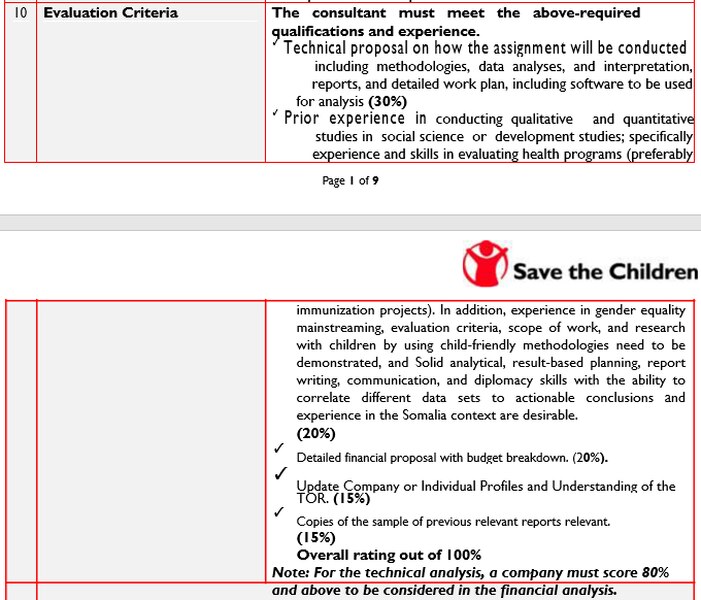
- A technical proposal with a detailed response to the TOR, with a specific focus on the scope of work, methodology, and timelines, and how the participation of children and persons and children with disabilities in the evaluation will be ensured.
- Initial work plan and an indication of availability.
- A financial proposal detailing the daily rate expected including accommodation, transportation, stationery, data collectors, research assistance, and all other cost related to this assignment. (Operational and consultancy fees).
- Company profile or CV including a minimum of 3 references.
- At least two previously conducted similar studies.
Supplier Sustainability Policy and the included mandatory policies: Click Here to Access
HOW TO APPLY:
Applications can be submitted by either:
Electronic Submission via ProSave (Recommended)
- Submit your response in accordance with the guidance provided in the below document:
Bidding on a
Sourcing Event.pptx
- Bidders are encouraged to apply via Ariba system. Please request the Ariba link via email sending your company profile and Business registration certificate/CV. Please address your request to apply via ProSave to
Electronic Submission via Protected Email box (Optional).
- Email should be addressed to [email protected]
- Note – this is a sealed tender box which will not be opened until the tender has closed. Therefore, do not send
tender related questions to this email address as they will not be answered.
- The subject of the email should be “PR350374-Third Part Monitoring (TPM) for SOM BHA 2023-24 Integrated Response in 3 Areas”
- ‘Bidder Name’, ‘Date’’.
- All attached documents should be clearly labelled so it is clear to understand what each file
relates to.
- Emails should not exceed 15mb – if the file sizes are large, please split the submission into two emails. Do not copy other SCI email addresses into the email when you submit it as this will invalidate your bid.
Your bid must be received, no later than 9th September 2023
Bids must remain valid and open for consideration for a period of no less than 60 days