


Job details
Posted Date
Dec, 05
Expire Date
Dec, 18
Category
Consultancies
Location
Somalia
Type
Consultant
Salary
---
Education
Masters
Experience
10+ years
Job description
Background and Justifications
Somalia has been facing critical climatic shocks and conflicts resulting in over 6.9 million people in need of assistance of which more than 3 million are in IDP camps. IDPs and host communities had been receiving meager assistance to cover their basic food and other needs and have stayed for decades in the IDP camp with reduced assistance. The IDPs had been hosting an ever -increasing influx of IDPs joining the already overwhelmed households. Though climatic and conflict issues continue to be a concern, the lack of resilience and viable livelihood opportunities has become a key factor constraining IDPs from breaking the cycle of poverty. The Federal Government of Somalia and the humanitarian organizations are struggling to provide necessary assistance to all affected populations> however, these actors are trying their level best to build the resilience of the disaster-affected populations through implementation of durable solutions.
There are an estimated over 1 million IDPs in Mogadishu and Afgooye areas, as well as a large population of returnees. Most IDPs come from regions bordering Banadir (the administrative region of Mogadishu), such as Lower Shabelle and Middle Shabelle, with others coming from slightly further away, from Bay. These three regions have seen significant clan conflicts and being amongst the hardest hit by frequent droughts over the last couple of years. Most of the IDPs situated in the target locations attain limited assistance due to the high number of IDPs population and living with vulnerable and extremely poor local communities in the suburbs of the city.
As stated in the Federal Somali Government Youth Policy document, 45.6% of the Somali population is below the age of 15, and 81% is below the age of 35, which reveals a significant youthful population. There are increasing concerns on how to develop and empower the youth who are the potential productive labor force and could have a significant contribution to the national economy. The current unemployment rate of the country is 19% where youth and women are the significant portion of the jobless population. The paper indicates that the youthful population has been vulnerable to various national problems, including conflict, climatic shocks and immigration-related issues. On one hand, Somalia has a strong entrepreneurial spirit, with a long history of business and a growing number of startups. The entrepreneurial spirit of Somali youth in Mogadishu is fueled by their resilience and adaptability in challenging environments. Despite the aftermath of conflict and significant socio-economic challenges, Somali youth have shown remarkable determination and motivation to create their own opportunities. The youth have the potential to engage in the local economy and benefit from the existing local jobs and micro businesses if the key barriers related to skills, access to services, market information and business set-up-related resources are addressed.
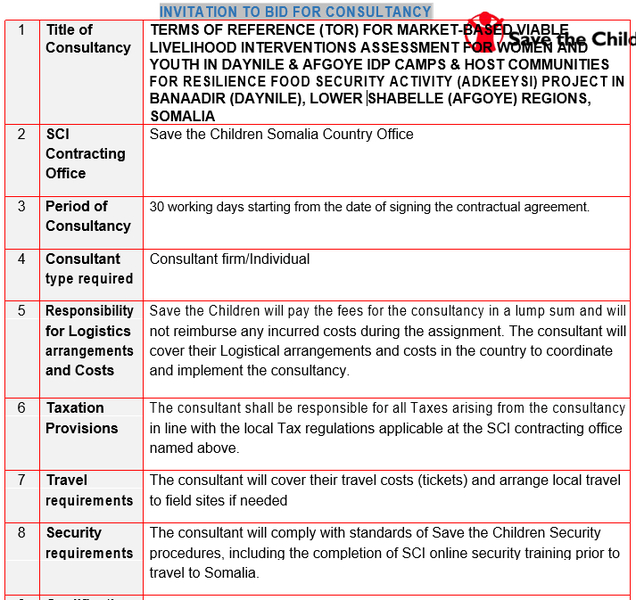
This assessment will deep dive to explore existing and potential off-farm and non-farm livelihood opportunities starting with the preliminary analysis conducted at proposal stage, validate the proposed options, and assess local micro-business, value chain, and paid employment opportunities. It will further identify skill requirements to meet the demands of the market/employers, key barriers to market-based livelihood diversification and design mechanisms to propose viable livelihood options for IDPs and Host community women and youth. in Daynile and Afgooye.
2. Project Specific information
The Resilience Food Security Activity (RFSA)/ Adkeeysi project, is a five-year Activity funded by the USAID/BHA, which started in October 2024. It is being implemented by a consortium of international and local non-governmental organizations: Save the Children Federation (lead agency), Gargaar Relief and Development Organization (GREDO), Shaqodoon, and AVSI. Adkeeysi, which means “resilience” in Somali, provides a locally customized classic graduation approach (GA) that carefully and deliberately sequences and layers five tested graduation components.
The overall objective (Goal) of Adkeeysi is for extremely poor and socially marginalized populations in IDP settlements and surrounding host communities to improve and maintain their food security despite
shocks and stresses. The purpose is for socially marginalized populations in both IDP camps and surrounding host communities to achieve resilience and sustainably graduate out of poverty. The purpose will be achieved through an integrated, gender-sensitive approach to deliver three complementary results/purposes:
Purpose 1: Social capital strengthened
Purpose 2: Human capital increased
Purpose 3: Prosperous and resilient livelihoods improved and sustained.
The Adkeeysi Activity focuses on two geographical areas namely Mogadishu and Afgoye. Daynile under the regional administration of Banadir (Mogadishu), and the Afgoye (Lower Shabelle) Corridor that connects Daynile to Afgoye. Selection of those areas was based on several factors, including the estimated numbers of IDPs and impacted host communities; the existing operational footprint and experience of the consortium partners; and possibilities for strategic synergies with ongoing public -funded programs and private sector actors, along with opportunities for urban-rural linkages. The current assessment will provide in-depth information and recommendations about the specific market-based viable livelihood opportunities and marketable skills for youth and women in Daynile and Afgooye locations for the Activity to prioritize during implementation, building on and deepening the preliminary options identified at proposal stage
3. Objectives of the Assessment
The major objective of the assessment is to identify locally viable livelihood opportunities with growth potential that are profitable and relevant to the target community. The assessment should also map out existing and potential service providers, end market actors and other stakeholders relevant to ensuring the sustainability of the livelihood strategies to be pursued by the ultra-poor women and youth in Daynile and Afgooye IDPs and Host communities benefit from non and off-farm opportunities.
The specific objectives of the study are as follows:
• Conducting deep dive study on proposed viable livelihood opportunities, Validating and updating based on potential market demand and profitability potential. This would include but not be restricted to:
• Identifying feasible market-based livelihood options addressing local wage employment and self-employment for women and youth considering the target group interest, skills and knowledge gaps and potential pitfalls for new businesses.
• Evaluating the feasibility and provide a shortlist of viable potential off-farm and non-farm activities, marketable skills and self-employment opportunities that are fit for the youth and women IDPs and Host communities.
• Selecting 5-7 short-term most preferred and feasible livelihood opportunities (both self-employment and skilled labor) that require micro-investments, allow for quick returns and have a better market potential for the target groups.
• Specifically analyzing demand factors to assess the size of the markets in local neighborhoods and communities for retail opportunities such as petty trade or services to avoid market saturation issues.
• Assessing the factors that promote or inhibit livelihood opportunities specifically looking at skills/knowledge requirements, need for capital investment, and other factors such as supply chains for inputs and access to output markets.
• Identifying specific service providers such as technical training or enterprise development services, business incubators etc. and recommending potential models for engaging with them.
• Identifying relevant market actors including employers, contractors, buyers, suppliers of raw materials/wholesale goods etc. and recommend specific opportunities for collaboration to facilitate linkages.
• Identify and assess existing Programs providing livelihood opportunities for the future synergy or complementarity
4. Assessment Methodology
To undertake the assignment, the consultant will use a combination of research methodologies to scope information, gather, synthesize, analyze, and generate comprehensive evidence. The analysis should ask questions about the needs, interests, and aspirations of Youth and Women in relation to the off-farm and non-farm job opportunity sectors. The assessment will use both secondary (Desk information) and primary data sources and will apply diverse qualitative and quantitative data collection techniques. The analysis should capture quantitative and qualitative data disaggregated by sex and age, and use participatory methods such as focus group discussions, key informant interviews, community mapping, etc. to generate statistical information and community testimonies.
The study should clearly show the below methodology of research of focus, emphasizing promoters and barriers of the identified livelihoods and indicate the necessary scale of consultations through KIIs and FGDs per location/market depending on the population, selected sectors and markets. The study should include, at minimum, the following:
2. KIIs or FGDs with relevant market actors and service providers
3. KIIs or FGDs with selected entrepreneurs or wage earners from target profile communities that are currently involved in the shortlisted L/Hs
4. FGDs with community women and youth representatives of potential target participants
• Conduct thorough Mapping and Analysis of the different stakeholders in the target location on youth and women livelihoods, collect existing experience related to local markets, behavior of actors, skill gaps, services and facilities, and overall access and barriers to the target group to the local markets.
• Triangulate- Reviewing thoroughly the available secondary information and conduct cross-validation to verify and include into the current study, and other locations with similar geographic and demographic situations in the country.
• Conduct Extended Qualitative Assessments on Youth and Women groups, youth employment agencies, youth aspirations, local employment opportunities, Skill Incubators, and overall labor market key actors applying FGDs (Focus Group Discussions), Key Informants Interviews (KIIs) and Observation.
• Conducting Stakeholder Consultation and Validation of findings on key major Youth and women livelihood options, existing local skills and capacities, barriers and existing services
• Collect and analyze relevant economic and financial data from secondary and primary sources in order to assess the economic feasibility and long-term sustainability of selected livelihood options.
• Apply feasible analytic techniques subject to diverse data collection methods and ensure data quality, consistency and relevance
• Assessment framework and data collection tools designed should be thorough and extensive consultations with SCI and Partners team
5. Time Frame
The consultancy work will start in December 2024 and will take 30 working days starting from the date of signing the contractual agreement and including a trip to Somalia to train the enumerators. The task is very time-sensitive, and hence in the work plan the consultant should present in detail how s/he will adhere to this timeframe.
6. Preparation of the Proposal
The consulting firm/bidder shall bear all costs associated with the preparation and submission of the proposal. The consultant shall submit two proposals-technical proposal (with a separate sealed and stamped envelope) and a financial proposal (with a separate sealed and stamped envelope) in a single envelope. The technical and financial proposals should be marked properly and should include the name and detailed contact address of the consultant /firm.
7. Required, Expertise, Experiences and Competence of the consultant
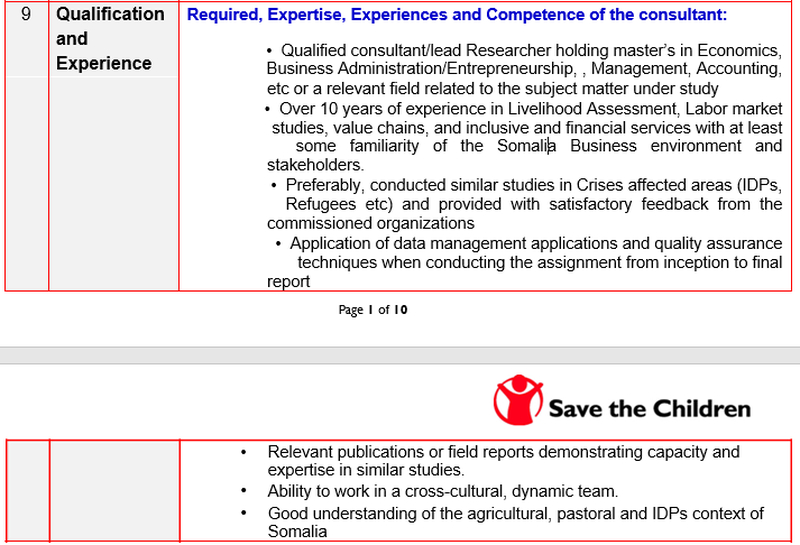
• Qualified consultant/lead Researcher holding master’s in Economics, Business Administration/Entrepreneurship, , Management, Accounting, etc or a relevant field related to the subject matter under study
• Over 10 years of experience in Livelihood Assessment, Labor market studies, value chains, and inclusive and financial services with at least some familiarity of the Somalia Business environment and stakeholders.
• Preferably, conducted similar studies in Crises affected areas (IDPs, Refugees etc) and provided with satisfactory feedback from the commissioned organizations
• Application of data management applications and quality assurance techniques when conducting the assignment from inception to final report
• Relevant publications or field reports demonstrating capacity and expertise in similar studies.
• Ability to work in a cross-cultural, dynamic team.
• Good understanding of the agricultural, pastoral and IDPs context of Somalia.
Skills and qualifications
How to apply
Submit your response in accordance with the guidance provided in the below document:
Application can be submitted either Electronic Submission via ProSave (Highly Recommended)
Option 1: ProSave (Highly Recommended)
Bidders are encouraged to apply via Ariba system (prosave) Please request the Ariba link via email sending your company profile and Business registration certificate/CV to the email. Please address your request to [email protected]
Option 2: Email Submission:
Qualified Consultancy Firms are requested to submit their technical and financial proposals and Lead consultant and associated personnel CVs and other relevant documentation to
Please note the following.
• Email should be addressed to[email protected] and should not be send any tender documents.
• Emails should not exceed 15mb – if the file sizes are large, please split the submission into two emails.
• Do not copy other SCI email addresses into the email when you submit it as this will invalidate your bid.
• All applications MUST be submitted on or before the closing date below to be considered for the assignment.
• The subject of the email should be FOR RESILIENCE FOOD SECURITY ACTIVITY (ADKEEYSI) PROJECT
• Submissions must be made to this email, attaching all relevant documentation.
• Interested consultant (s) who meet the consultancy requirements are requested to submit their bid and each application package should include the above required minimum requirements.
Do not send tender related questions to this email address:
[email protected] as they will not be answered. The subject of the email
should be “CONFLICT MAPPING AND ANALYSIS Only shortlisted bidders will be contacted.
PROPERTY RIGHTS:
All data that will be collected should be considered as SCI properties and may not be used for other purposes.
13 Closing date for Applications
Interested consultants shall submit their applications through the above procedures on or before. 18th December 2024