
Job details
Posted Date
Aug, 21
Expire Date
Aug, 29
Category
Research/translation/report And Writings
Location
Somaliland
Type
Consultant
Salary
---
Education
Masters
Experience
7 - 8 years
Job description
Terms of Reference for the Baseline ResearchSupport to the Africa Led Movement to End Female Genital Mutilation (FGM)
Location:
Somaliland (Sool and Sanaag Regions)
Duration:
30 Working days
Critical Interface:
MEAL Department
Consultancy Type:
Local/International
Travel:
Required
Summary
The UK Government (Foreign, Commonwealth and Development Office - FCDO) has a vision of a world free from Female Genital Mutilation/Cutting (FGM/C) by 2030, which is in line with the Sustainable Development Goals (SDGs). The importance of eliminating FGM/C is reflected in Target 5.3 of the SDGs:” Eliminate all harmful practices, such as child, early and forced marriage and female genital mutilations.” A programme has been established entitled ‘Support to the Africa-led movement (ALM) to end FGM/C’ to contribute to global efforts to achieve that vision. Building on the foundations of the first five-year investment (2013-2018) of the Department for International Development, this programme is focusing on accelerating the pace of change and achieving results to contribute to the vision in the SDGs of a world free of FGM/C by 2030. More specifically, this program is supporting and building the capacity of the ALM to end FGM/C at multiple levels and at scale. The ALM is not working in isolation, but works in partnership with the rest of the FGM/C community/movement at all levels, complementing the work of UN agencies (such as UNFPA-UNICEF Joint Programme), Saleema initiative, other alliances (such as Girls not Brides, She Decides, FEMNET, Global Citizen, One Campaign) and grassroot Civil Society Organisations (CSOs), women’s and girls’ movements, etc. Phase II is composed of two consortia working in close collaboration: Options is engaging with Amref Health Africa, ActionAid UK, Action Aid Somaliland, Orchid Project, ACCAF and University of Portsmouth to implement the ‘Support to the ALM to End FGM/C’ in cooperation with Population Council that will implement ‘The FGM Data Hub: Data and Measurement Support to the ALM to end FGM/C’.
As part of the wider consortium, ActionAid is delivering a package of community implementation interventions, in order to engage community members, girls, women, men and other stakeholders in order to shift attitudes and behaviors towards the practice of FGM/C. In the first year of the programme, the consortium is focusing delivery on Somaliland led by ActionAid International Somaliland (AAIS). This baseline research is to collect data against the specific indicators for reporting against the programme outcomes and outputs, which will supplement baseline data collected by other partners.
Programme Vision
A world where girls and women can exercise their power and rights, have expanded choice and agency, and be free from violence including FGM/C
Programme outcome
Acceleration of positive change in social attitudes towards ending FGM/C in countries/regions in which the programme is operational
ActionAid Somaliland Project Outcomes
Outcome 1: Acceleration[i] of positive change in social attitudes towards ending FGM/C in countries/regions in which programme is operational
Output 1(OP1): Enhanced support to communities with a structured package of interventions to influence attitudes and practices towards FGM/C: Support to communities with end FGM/C interventions at community level. A vulnerability assessment will be conducted to help the most vulnerable people to take part in the project activities to help ActionAid to understand the nature of vulnerability and its root causes. In addition, ActionAid will support communities to conduct monthly community dialogues by discussion FGM/C. Support school youth clubs and establish and support women safe spaces.
Output 2 (OP2): Provision of small grants to build the capacity of grassroots women-led, girl-led, women’s rights and youth-led organizations and activists to end FGM/C: The project is endeavoring to promote grass rout level by improving level of knowledge of girls and boys aged 10-19 years old, change in beliefs about FGM/C among participating girls and boys aged 10 – 17 years. Level of agency, decision-making power, and leadership among participating girls aged 10 – 17, Shift in egalitarian beliefs about men and women/boys and girls, including gender roles and End FGM/C social movement scorecard score, county level.
Output 3 (OP3): Integrating end FGM/C interventions into existing development programmes: Since FGM/C is multi-dimensional issue, the project is trying to address the problem integrating and mainstreaming development project on community awareness and campaigns. In regard, extent to which a cohort of medical change agents is established within medical/health training programmes, level of knowledge and capacity demonstrated by trained medical/health students to prevent and manage FGM/C cases, Level of integration of the FGM/C training curriculum by stakeholders’ interventions for FGM/C prevention and care and Extent to which an effective model for integrating end FGM/C interventions into broader development programmes has been developed.
Output 4 (OP4): Strategic use of media and campaigns to influence attitudes and practices towards FGM/C: Media campaigns are recently discovered as powerful channel to influence people, to do this the project is training media personal on how best they can organize and broadcast FGM/C subject to their watchers.Output 5 (OP5): Global advocacy – increased commitment to ending FGM/C at all levels. The project also advocates to collective commitment to end FGM/C at all levels at the continental and the global at large.
Output 6 (OP6): Enhanced evidence and learning to improve programming to end FGM/C: Proper learning and documenting the prevalence of the FGM/C and its cause roots is seen as integral angle to figure out the situation at country, continental and global. As such the evidence base learning
Background Information
The Support to the Africa Led Movement to end FGM is underpinned by the evidence that social movements must be built from the ground up. This entails the formation of trusted relationships which allow for local adaptation of key messages with pathways of change. The foundation will be built on evidence and learning which will be used to initiate or accelerate progression through stages of change at all levels. There is growing consensus that this work needs to be participatory, use rights-based approaches working with community ‘change agents’ and be grounded in deep community knowledge and strong partnerships. We know that prioritizing the agency of girls, promoting their rights and development and recognizing the importance of positive family and community roles in girls’ lives can lead to effective abandonment of FGM/C. There is also growing consensus that grassroots organizations are in the best position to understand the dynamics of change around FGM/C decisions making, identify key influencers and how best to mitigate against backlash to change.
ActionAid International Somaliland is un-apologetic in advancing Women’s Rights ensuring that women living in poverty and exclusion are at the center of our work in Somaliland. Our work on VAW/G is guided by our Human Rights Based Approach (HRBA). It is anchored on the recognition that VAW/G is a violation against girls and women; it violates their human rights to life, dignity, health and bodily integrity. We therefore work with communities, women rights networks and key stakeholders to reduce cases of VAW/G being aware that challenging violence needs to take place at all levels. We create awareness and educate communities on how violence violates girls’ rights and the protection provisions of the law. We support girls at risk of VAW/G and the survivors and affected to demand action by local and national governments.
Objectives and purpose of the baseline study
The overarching objective: The overall objective of the baseline is to collect data against the ActionAid International Somaliland (AAIS) project indicators outlined in the results framework (Annex 1) at outcome and output level and ALM-FGM program Design (Annex 2). The data collected will be used to populate the baseline data in the AAIS Results Framework against each indicator.
Objectives:
- To identify qualitative and quantitative baseline data for outcome and output indicators in the AAIS Results Framework that will guide in establishing the subsequent targets for the project.
- To analyse the baseline data and populate the AAIS Results Framework as per the outcome and output indicators.
- To assess, document lessons learnt, and challenges experienced during the study and provide recommendations for adaptation in the project implementation.
- To gather any relevant information on the context as it relates to FGM/C in the geographical locations targeted by the programme, which might inform the inception and implementation of the programm
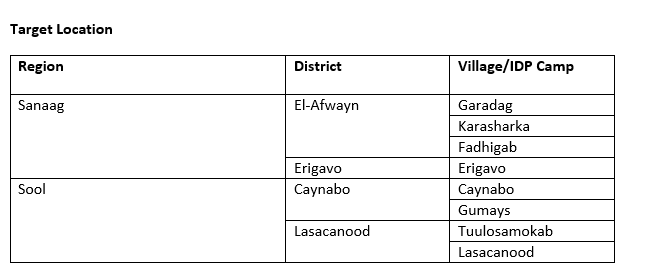
The consultant will work with their team and with the support from AAIS to provide relevant project information, data, and documentation. In addition, the consultant will be required to interact with the project participants to collect the baseline data against all indicators at outcome and output levels in Ainabo, Lasacanood districts of Sool region and El-Afwayn, Erigavo districts of Sanaag region. Lessons learnt/challenges and recommendations will also be generated from the data analysis and feedback from project participants, and AAIS.
Scope of the review
Using a feminist approach to monitoring and evaluation, the consultant will be
required to undertake the following:
- To review the relevant project documents as well as relevant ActionAid and consortium documents to inform the literature review and provide secondary data for the baseline report.
- To work with ActionAid’s International Somaliland Team for the above processes
- To develop and provide a workplan, inception report and tools that will guide the collection of the baseline data and development of the draft report.
- To conduct the baseline study using methodology and tools developed and approved by ActionAid International’s Somaliland (AAIS) team, with support from the MEL lead at ActionAid UK.
- To train and supervise the data collection enumerators for data quality assurance.
- To analyse data collected, compile and interpret for compilation into a draft report. To develop a draft and final report, this will include a comprehensive and rigorous baseline data collection methodology and tools, methods for analysis and proposed structure for the final report.
- To populate the log frame with the baseline data collected as per the project outcome and output indicators.
- To develop and present a summary PPT and presentation of key findings and recommendations.
Other limitations: The consultant and team will need to take into consideration national and international standard protocols of limiting the spread of COVID-19 and adapt where necessary. In addition, the consultant needs to take into consideration the situation of the drought existing in the country while collecting primary information from the field.
Expected baseline study approach and methodology
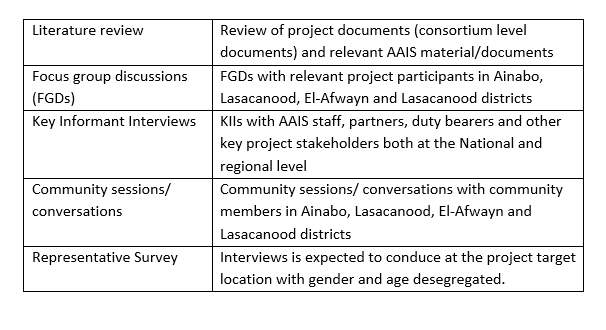
The consultant will be responsible for producing a comprehensive mixed-method methodology as well as a detailed work plan for delivering the baseline study. The methodology developed must include sampling procedure and a representative sample size; data collection instruments; and data analysis methods. An initial brief but clear methodology will be submitted in the technical offer and will be part of the assessment for selecting the successful consultant. All data, qualitative and quantitative, collected and reviewed through the study must be disaggregated by sex, age and disability as a minimum. The successful consultant will be expected to operate within AA global feminist principles and information on this can be found here: How we practice feminism at work | ActionAid UK
The methodology of the baseline review will include but not be limited to the following methods:
ActionAid fully expects this baseline to be carried out in line with our Evaluation Standards, to ensure consistency with our Human Rights Based Approach as highlighted below:
Coordination, roles and responsibilities
AAIS will provide the overall guidance and supervision of the task through its Programme Team. The consultant (s) will work closely with the MEL Coordinator, Project Manager and Project Officer, and Women Rights Lead, in the project areas. The overall accountability of this work rests with Programs and Strategy lead at ActionAid Somaliland. Official transport shall be incurred by the consultant as the consultancy cost was designed to cover all logistics and travel expenses.
Expected Outputs
The Consultant will be required to submit the following:
- A workplan and inception report
- A draft and then final baseline study report, together with summary report.
- The baseline report must not exceed 35 pages, (excluding annexes) as a Word document written in clear and concise English with minimal jargon. The report will include:
- Cover page (title of the baseline report, date, name of consultants, photo)
- Contents table
- Executive summary of no more than 2 pages outlining the purpose of the baseline review, main points of analysis, key findings, conclusions and recommendations
- Introduction outlining the background to the intervention and the baseline
- Purpose and objectives of the baseline
- Methodology/approach, indicators used, and limitations of the baseline
- Major findings (data analysis, including gender analysis)
- Lessons learned, challenges, ways to mitigate challenges and maximise lessons learnt and recommendations
- Annexes: details of data collection tools, schedule of field visits and meetings; list of people interviewed; bibliography of key documents consulted; TOR for the evaluation
- The AA Somaliland results framework populated with the baseline data against each indicator at outcome and output level
- A PowerPoint presentation summarising key findings and recommendations that can be used to disseminate findings within ActionAid and with external stakeholders. The consultant and team are required to make a presentation of key findings and recommendations to the AA Somaliland and AA UK project team.
- The raw data (all transcripts, quantitative data, data collection tools) must be handed over to ActionAid together with the evaluation report. Where photos are included, these should be provided to ActionAid in high resolution JPEG format and catalogued by ActionAid on Stories hub according to our photo guidelines. The evaluation team must ensure photos are obtained in line with ActionAid guidelines on consent. Diagrams/flowcharts/infographics developed by the evaluation team can be included but the original artwork should also be submitted as separate files along with the evaluation. Note ActionAid reserves the right to modify artwork as appropriate. All deliverables must be based on evidence collected during the process e.g. photos, case studies, qualitative and quantitative data.
- In addition to the raw data, we would expect the data collection tools themselves (e.g. FGD guides, survey in .xls form, etc.) so that we can use them for ongoing monitoring purposes and thereby ensure consistency between what we collect and what was collected at baseline
Expected Timetable
The consultant and team will prepare a work plan that will operationalize and direct the baseline study. The work plan will describe the baseline study to be carried out, bringing refinements, specificity, and elaboration to this ToR. The assignment is expected to be carried out within a period of 6 weeks starting from the contract sign date. Field work is expected to be carried out for 4 weeks days in Ainabo, Lasacanood, El-Afwayn and Erigavo. The assignment schedule will be approved by the country Program Manager as the agreement between parties on how the evaluation will be conducted.
Budget
The evaluator is expected to give a detailed breakdown of the budget outlining the professional fees and administration costs. The budget should align with the workplan for Ainabo, Lasacanood, El-Afwayn and Erigavo and demonstrate value for money and that maximizes potential efficiencies to deliver the outputs within budget. All travel, logistics and accommodation fees should be outlined in the budget proposal.
Skills and qualifications
Evaluator qualifications
We are looking for an evaluator with the following key skills and capacity. These criteria will be used to assess applications alongside applicants’ technical proposals.
General criteria:
- A master’s degree or work experience in social sciences
- At least 7 years of experience in developing and carrying out monitoring and evaluation (MEL) systems, baselines, and evaluation design from a feminist lens with diverse knowledge in mixed methods approach
- Proven experience in participatory approaches to designing and delivering baselines
- Demonstrable expertise and experience on FGM/C, women’s and girl’s rights, GBV and gender equality and HRBA
- Experience and willingness to work in the Geographical areas of Ainabo, Lasacanood, El-Afwayn and Erigavo.
- Proven cross-regional experience would be preferable
- Excellent facilitation skills
Technical criteria
- Experience in qualitative and quantitative methodology, methods, tools and analysis and visualization.
- Experience in participatory and community-led approaches
- Demonstrable knowledge and skills in development and use of online data collection methods and tools for data collection and analysis.
- Evidence of strong downward accountability mechanisms used with project stakeholders/research participants to actively share results and learning.
- Evidence of use of ethical considerations and methodological measures that respect the rights of all stakeholders
- Evidence of successfully designing and managing large-scale, rigorous and robust research processes and evaluations.
- Evidence of producing clear, concise and high-quality reports in English
How to apply
All applications should include the following documents:
- The CV(s) of the lead consultant and the team of applicant(s)
- A covering letter or expression of interest - highlighting relevant experience and skills to the specific baseline study, and the reasons for interest in the work
- A brief technical proposal with a cover letter demonstrating how the evaluator or evaluation team meet the consultant experience and expertise specification. (1page Cover letter and 8 pages maximum or the proposal)
- A separate financial proposal with a clear distinction between fee rate and expected logistics costs (3 pages maximum)
- Examples or links of similar work / baseline reports
- The names of at least 2 previous clients to contact for references.
Applications will be submitted via email to [email protected] on or before 28th August 2022.
..................................................
NAGUSOO BIIR --- SOMALI JOBS
Telegram: https://t.me/somalijobsinc
Linkedin: https://www.linkedin.com/company/somali-jobs/
Facebook: https://www.facebook.com/somalijobs
Facebook Group: https://www.facebook.com/groups/somalijobs
Twitter: https://twitter.com/somalijobs
Instagram: https://www.instagram.com/somalijobs/
Application: https://play.google.com/store/apps/details?id=com.tiriig.somalijobs
.................................................