

Job details
Posted Date
Apr, 11
Expire Date
Apr, 21
Category
Assessment/evaluation/audit
Location
Somaliland
Type
Consultant
Salary
---
Education
Masters
Experience
5 - 6 years
Job description
Profile
ActionAid International founded in 1972, is an independent and a non-governmental global federation working for a world free from poverty and injustice. It works to achieve social justice and gender equality, and to eradicate poverty. And AAIS was registered as an international organization and established in Somalia in 1992. AAIS is undergoing several changes to become more sustainable, internally capable to drive external impact on its mission and achieve the aspirations as articulated in its Country Strategy Paper (2020-2024) named People’s Action Toward Social Justice.
Project Information
An estimated 6.7 million people (about 40.89% of the total population of Somalia/Land face food insecurity (FSNAU). The recuring drought, effect of COVID 19 pandemic, food and fuel supply chain disruption consequent upon Russia war in Ukraine are deepening injustices, widening poverty gap, and exacerbating pre-existing vulnerabilities. The project will strengthen the collective action and entrepreneurship skills of existing women groups in the three Local Rights Programs (LRPs) communities. It will also advocate inclusion of women in the economy through creation of an enabling environment.
The project will also facilitate the women groups to form district and regional platforms and join hands with youth groups for bigger voices. This project matters because it will build the leadership and agency of women and youth led (not exclusive to women) local groups/producers to become active change agents, who design and implement Community Based Adaption (CBA) Plans constituting disaster risk reduction (DRR), and agroecology-cum-agroforestry as its primary elements. The women groups have safe spaces to share information, strategize and advocate for their rights, and raise the awareness of the community on the harmful practices like FGM/C the prevalence with is about 98%.
Solving the Problem:
- Capacity enhancement and application of women and youth farmers on CBA, DRR and wide-spread adoption of agroecology practices to transform agriculture systems and bolster food rights.
- Establishment of a women and youth led climate justice movement which engages in critical policy spaces at local, national, and regional level, connecting to global advocacy for the adoption of agroecology policy and the shifting of humanitarian resources and decision-making power.
- Facilitate opportunities for women’s economic empowerment, and advocacy on increasing women small business owners’ access to finance.
- Linking the women groups in the LRPs to formal credit providers and other financial institutions for investments and soft loans.
- Linking the grassroots women and youth groups to the national women and youth networks for wider social influences and lobbying with the national decision makers.
Expected Results
- Smallholder farmers, particularly women and young people are empowered to understand climate trends and to become change agents who develop and implement CBA plans and lead widespread adoption of agroecology., agroforestry, and gender responsive DRR
- Increased integration of community work (through the climate justice movement) with systematic organizing, movement-building and public engagement to link local rights-holders to wider constituencies nationally, regionally, and globally.
- Increased access to skills and financial/non-financial business development services to improve income-generating capacity, productivity and competitiveness of women SMEs.
Transformative Ambition
Expected Impact: Improved income, livelihoods, resilience, and adaptation of communities, especially women and youth, in Somalia/Land to climate change.
Outcome/Overall Objective: To build the resilience of vulnerable communities in Somalia/Land to climate change’s impacts and variability through a transformative women-led community-based adaptation framework focusing on agroecology, agroforestry, disaster risk reduction and policy integration at local, national, regional, and global levels, inclusive of climate change’s incidental societal impacts.
Outcome 1: Smallholder farmers, particularly women and young people are empowered to understand climate trends and to become change agents who develop and implement CBA plans and lead widespread adoption of agroecology, agroforestry, and gender responsive DRR.
Outcome 2: Community work (through the climate justice movement – Cadaaladda Cimilada Action Groups and through ActionAid’s Women’s Safe Spaces) is integrated with systematic organising, movement-building and public engagement to link local rights-holders to wider constituencies regionally, nationally, and globally to influence policy and practice in climate justice, agroecology, gender responsive DRR and to address the communities’ needs relating to all impacts of climate change and climate-induced crises
Outcome 3: Women small business owners acquire skills and financial/non-financial business development services and improve income-generating capacity, productivity, and competitiveness.
Objective of the Baseline.
The consultant will be responsible for producing a comprehensive mixed-method methodology as well as a detailed work plan for delivering the baseline study. The baseline will include traditional knowledge, current practices on CBA, DRR, disaster preparation, agroecology, and policies at the local, national, and regional levels on CBA, disaster management, and agroecology and resilience. As well as mapping common CBA and agroecology practices across districts, including identifying/developing/adapting relevant CBA and Agroecology training material. To ensure that all milestones are fulfilled, the consultant will collaborate closely with the Resilience Programme Coordinator and the Monitoring and Evaluation team.
Overall, the baseline and Needs Assessment aims to
- Collect baseline indicators for the project and data on the needs and situations of climate challenges and trends.
- Provide recommendations for how to engage and empower women and girls in the community outreach activities, develop workplans and implement CBA plans.;
- Analyse the fundamental origins and core causes of community climate vulnerabilities, as well as their consequences on community resilience.
- Record lessons gained and best practices for use in recommendations and planning phases.
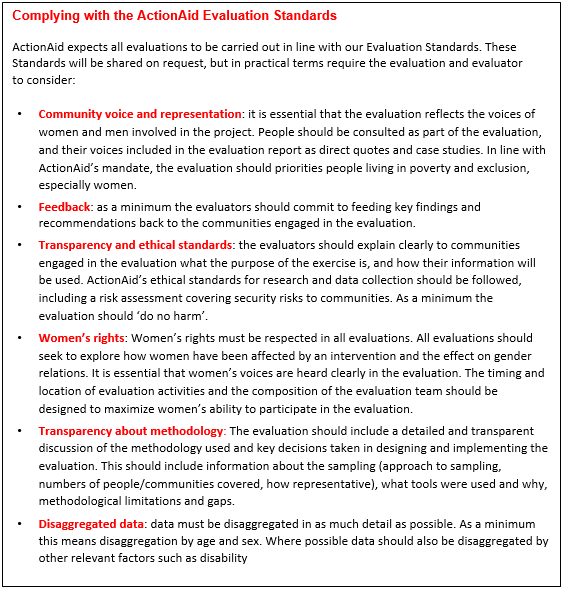
The methodology developed must include sampling procedure and a representative sample size; In addition, the study should employ both quantitative and qualitative participatory methods to establish the project data while employing data collection instruments, and data analysis methods. An initial brief but clear methodology will be submitted in the technical offer and will be part of the assessment for selecting the successful consultant. All data, qualitative and quantitative, collected and reviewed through the study must be disaggregated by sex, age, and disability as a minimum. The successful consultant will be expected to operate within AA global feminist principles.
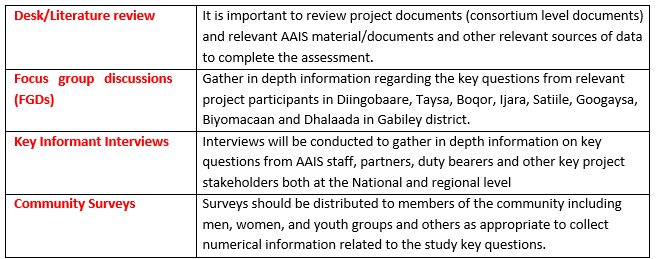
The baseline and need assessment will draw on the following sources:
Expected Deliverables.
The Consultant will be required to submit the following:
- A workplan and inception report: Within Ten days from signing the contract, the consultant should submit an Inception report, which clearly defines the evaluation methodology, such as clear outlines for the focus group discussions, KII questions, survey questionnaires and research timeline with specific deadlines for each deliverable. The inception report should also clearly explain the sampling methodology and sample size for the quantitative survey and a clear and logical number for the KIIs. The report will also include an evaluation matrix to ensure evidence -based findings and triangulation.
- The full inception report and the data collection tools need formal approval from before starting the data collection in the field.
- A draft Baseline Assessment report to be submitted within 10 days of completion of the data collection for review and comments from AAIS country team and the Monitoring & Evaluation Team. The review and feedback of the report could be more than one round depending on the quality of the report and the extent to which the comments and suggestions from the first round have been incorporated.
- A Final Baseline Assessment to be submitted after incorporating the comments of AAIS. The report should be written in English and Not exceed 30-35 pages excluding annexes consisting of:
- Cover page (title of the baseline report, date, name of consultants, photo)
- Table of Contents; list of acronyms, abbreviations and list of tables and charts.
- Executive summary of key findings and recommendation no more than 2 pages.
- Background information and context analysis presented by key criteria with brief description.
- Baseline methodology with clear explanation of sampling and limitations, KIIs, participants’ selection and data analysis approach.
- Research findings, analysis, with associated data presented, where appropriate in clear graphs or charts.
- The findings can include subsections for each research criterion.
- Appendices should research instruments, list of interviewees. document consulted. Updated logical framework with baseline measures for relevant indicators.
- Conclusion and Recommendations. They should be framed according to baseline indicator data and study.
- The study should be submitted electronically in a MS – Word document. The consultant is responsible for English editing of the final report which should be well formatted.
- Annexes: details of data collection tools, schedule of field visits and meetings; list of people interviewed; bibliography of key documents consulted; TOR for the evaluation
- A PowerPoint presentation with key findings and recommendations to be presented for ActionAid and external stakeholders.
- The raw data (all transcripts, quantitative data, data collection tools) must be handed over to ActionAid together with the evaluation report.
All handwritten and electronic transcripts of interviews and KIIs, hard copies of survey questionnaires, photographs taken during the assessment and any equipment received from AAIS for the purpose of the study should be submitted to AAIS. Furthermore, all information generated during the baseline study will be the sole property of AAIS and is subject to submission to AAIS along with the final report, prior to the end of the contract.
Expected Timeline
The consultant and team will develop an action plan to guide and implement the baseline study. The work plan will define the to-be-conducted baseline study, adding refinement, specificity, and elaboration to these Terms of Reference. The assignment is anticipated to be completed within eight weeks of the contract's signing date. Field work is expected to be carried out for 8 days in Diingobaare, Taysa, Boqor, Ijara, Satiile, GoogaysaGoray, Biyomacaan and Dhalaada. The Country Program Manager will endorse the assignment schedule as the accord between parties on how the evaluation will be conducted.
Budget Breakdown
The consultant is expected to provide a comprehensive budget breakdown delineating the service charges
and administrative expenses. The budget should be consistent with the workplans for Diingobaare, Taysa,
Boqor, Ijara, Satiile, GoogaysaGoray, Biyomacaan, and Dhalaada, demonstrate value for money, and
maximize potential efficiencies to deliver the outputs within budget. All travel, logistics, and lodging
expenses must be detailed in the budget proposal.
Skills and qualifications
Consultant Qualifications
- AAIS seeks an experienced Consultant with the following qualifications: Master’s degree in related areas or work experience in social sciences & climate resilience.
- Excellent written and spoken English skills required, including demonstrated ability in writing briefing papers and other information products.
- At least 5 years of experience in developing and carrying out monitoring and evaluation (MEL) systems, baselines, and evaluation design from a feminist lens with diverse knowledge in mixed methods approach.
- Proven experience in participatory approaches to designing and delivering baselines.
- Demonstrable expertise and experience in resilience and livelihood programing.
- Excellent facilitation skills and experience in developing and managing Focus Group Discussions, Interviews, and Surveys.
- Experience in qualitative and quantitative methodology, methods, tools and analysis and visualization.
- Demonstrable knowledge and skills in development and use of online data collection methods and tools for data collection and analysis.
- Evidence of strong downward accountability mechanisms used with project stakeholders/research participants to actively share results and learning.
- Evidence of use of ethical considerations and methodological measures that respect the rights of all stakeholders.
- Evidence of successfully designing and managing large-scale, rigorous, and robust research processes and evaluations.
- Evidence of producing clear, concise, and high-quality reports in English.
How to apply
To apply, interested candidates (Individuals or teams) are requested to submit the following documents:
- Curriculum Vitae (CV)(s) of the lead consultant and the team of applicant(s)
- A covering letter or expression of interest - highlighting relevant experience and skills to the specific baseline study, and the reasons for interest in the work.
- A brief technical proposal with a cover letter demonstrating how the consultant or evaluation team meet the consultant experience and expertise specification. (1page Cover letter and 8 pages maximum or the proposal)
- A separate financial proposal with a clear distinction between fee rate and expected logistics costs (3 pages maximum)
- Examples or links of similar work / baseline reports
- The names of at least 2 previous clients to contact for references.
Applications will be submitted via email to [email protected] on or before 20th April 2023.