
Job details
Posted Date
Sep, 25
Expire Date
Oct, 09
Category
Consultancies
Location
Somaliland
Type
Consultant
Salary
---
Education
Degree
Experience
Unspecified
Job description
Terms of Reference for Review of EMIS procedures and development of training curriculum for MOEs staff on tracking attendance and retention in Somaliland
Projects Names: Girls Education Empowerment Project in Somaliland (GEEPS)
Location(s) of the action: Somaliland
Organization: CARE International
Duration: 15 days
Start date: September 2022
Project Background
CARE is a humanitarian non-governmental organization committed to working with poor women, men, boys, girls, communities, and institutions to have a significant impact on the underlying causes of poverty. CARE seeks to contribute to economic and social transformation, unleashing the power of the most vulnerable women and girls. CARE has been providing emergency relief and lifesaving assistance to the Somali people since 1981. The main program activities since then have included projects in water and sanitation, sustainable pastoralist activities, civil society and media development, small-scale enterprise development, primary school education, teacher training, adult literacy, and vocational training. CARE works in partnership with Somali and international aid agencies, civil society leaders and local authorities. CARE International is currently operational in Somaliland and the strategy is: adopt a program approach to demonstrate impact and promote organizational learning; reduce the impact of emergencies on vulnerable communities, particularly women and children; improve governance and access to services and resources.
Girls Education Empowerment Project in Somaliland (GEEPS)
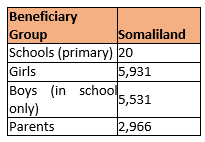
CARE’s Global Affairs Canada-funded Girls Empowerment and Education Project in Somaliland (GEEPS), a three year initiative (2020-2023) which aims to improve learning outcomes for girls, adolescent girls, and young women, in Somaliland. GEEPS will contribute to address one of the major barriers to development in Somaliland - the gender gap in education - at its most critical point, when girls reach adolescence. The project responds to this persistent need at a time when the COVID-19 crisis threatens to further worsen education outcomes for the most marginalized girls and wipe out years of development gains. GEEPS’s design builds upon robust evidence of what works to provide a holistic intervention that will improve equity in access, learning and retention in a sustainable manner through the combination of social norm change, girl-led action, improved school practices and strengthened system capacity to address gender and inclusion issues. The project uses a multi-layered intersectional approach that considers the intersections between gender, disability, ethnicity, clan identities and climate change, acknowledging the diverse needs and conditions of different population subgroups in Somaliland. GEEPS’ design builds upon three existing models with demonstrated impact in the Somali context: SOMGEP-T’s gender-focused teacher training, Girls’ Empowerment Forums and gender training for CECs. GEEPS leverages CARE’s existing interventions, research capacity and relationships for increased efficiency in the use of resources; responsiveness to a dynamic environment; increased reach among the most marginalized girls; and inclusive dialogue to support implementation processes.
Rationale for the assignment
In the context of Somaliland, the gross primary enrolment rate is estimated to be as low as 24%. Furthermore, the central Education Management Information System (EMIS) data does not fully capture the actual numbers of out-of-school children or wastage of system resources due to dropout. The existing systems do not sufficiently report disaggregated data of marginalized, disabled children. The current EMIS collects data on enrolment. Within-grade dropout is not tracked; neither is transition from one grade to another or between levels. The system is also not tracking what happens to those that leave school (nor flag the ones who are at risk of dropping out).
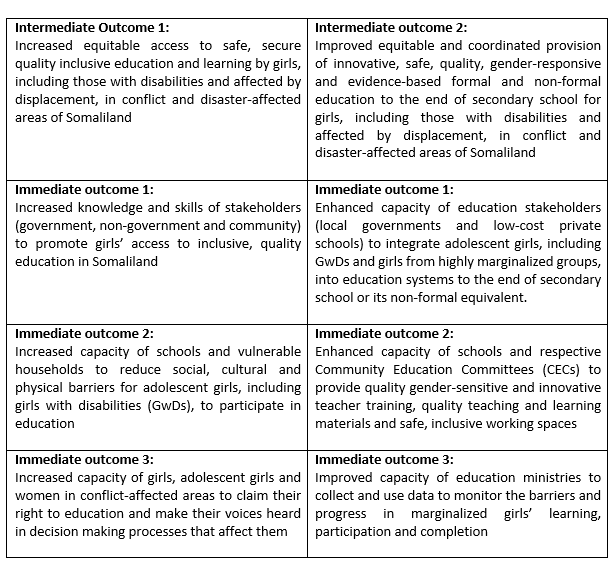
The ultimate goal of GEEPS is improved learning outcomes for girls, adolescent girls, and young women, including those with disability in fragile and conflict situations in Somaliland. GEEPS will implement an integrated and innovative package of interventions that intend to: 1) Increase equitable access to safe, secure, quality, inclusive education and learning by adolescent girls, including girls with disabilities (GwDs) and girls from traditionally marginalized groups and those heavily affected by conflict and displacement; and 2) Enhance quality, gender responsiveness and inclusiveness of the Somali education system at all levels addressing the needs of marginalized girls, including those with disabilities, in service provision. The project will directly reach and improve the learning outcomes among 5,931 new girls; as well as directly impact out-of-school girls, girls with mental health and non-mental health disability, and parents in Somaliland.
The projects will leverage the work done by GPE-funded ESPIG and the FCDO-funded and SOMGEP-T projects on the EMIS and will aim to further improve the system without duplication and replacement of the existing processes already in place.
Overall Objective of the assignment
The main objective of this assignment is:
- Review the existing EMIS procedures for tracking attendance and retention, including disaggregation by gender and marginalization (IDP status, clan, disability, language, etc.)
- Review the existing Strategic Plan indicators to track progress on marginalized girls’ outcomes
- Train gender focal persons and MOEs officials on data collation, analysis and
- To develop a common understanding on the definition of OOSC and outline existing gaps in recordkeeping at school level, informing system-level actions to improve OOSC tracking. This should include disaggregation by gender and marginalization (IDP status, clan, disability, language, etc.).
Specific objectives of the assignment
The specific objectives of this assignment are:
- To identify school-level gaps in tracking attendance and retention and underlying causes of those
- To develop a training curriculum for MOE staff to track attendance and retention by gender and marginalization (IDP status, clan, disability, language, etc.). The curriculum will have a particular focus on ensuring that tracking processes capture data on re-enrolment, attendance, retention, transition, and completion of complete cycles for marginalized children, such as former OOSC.
- To train FMS MoE staff, including Gender Focal Points, on the roll-out of the of the tracking system across all the states
- Review the recent gender responsive monitoring checklist developed under GEEPS for REOs, DEOs, GFPs and QAS to ensure methods of assessing educational delivery at the level of the teacher, the class, the school, and the region are standardized as well develop coaching guideline to use for the training of REOs, DEOs, GFPs on the use of monitoring checklist
CARE’s Role and Responsibility
The role of CARE with regard to this assignment will include but not be limited to:
- Review proposed methodologies, tools, plans, and reports produced by the consultant and advise where necessary.
- Coordinate meetings, discussions, or consultations with MOE regarding the assignment including the selection of the workshop participants and other support as may be appropriate.
- Make available relevant project documentation to support this assignment (e.g. GEEPS own OOSC enrolment monitoring system/database).
Scope of Work
- Review of school-level recordkeeping processes for attendance and retention, and identification of underlying causes of gaps in recordkeeping.
- Review of the EMIS and Strategic Plan indicators – the consultant will conduct a review of the current EMIS procedures in tracking attendance, retention, and transition and identify gaps. This will pay particular attention to gender and marginalization (IDP status, clan, disability, language, etc.).
- Revise the supervision checklist to include details of the new EMIS system to ensure all information on education service delivery is fully captured
- Develop a training curriculum on the new system and train 7 MoE staff, including Gender Focal Points, REOs and DEOs.
Deliverables
The main deliverables for this assignment are as follows:
- Inception report (EMIS Review/ School Recordkeeping Review report): providing details of the existing EMIS procedures for tracking attendance, retention, and transition, and the Strategic Plan indicators in these areas, as well as the levels of disaggregation available.
- Pilot of the data collection tools and use of the e-tools/ software
- Training curriculum for MOE staff on the new system
- Training of MoE staff who then cascade the training to selected system end users at school level.
- Presentations of deliverables as an integral part of the submission process.
- Revised gender sensitive monitoring checklist and coaching guideline
- The final report on the data collection and the training of MoEs
Duration of the Consultancy
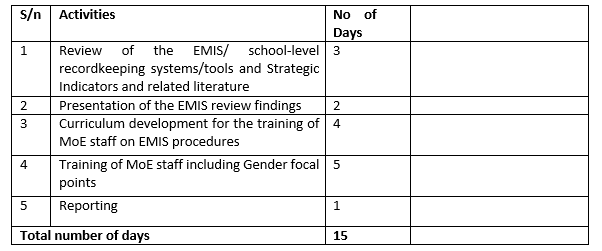
The consultancy shall be executed within a maximum of 15 days, commencing after signing the contract. The proposal should include a detailed schedule. The following should be used as a guide.
Skills and qualifications
Professional Skills and Qualifications
Qualifications:
- Graduate degree in Education preferably in educational planning
- Previous experience of setting up and/or reviewing EMIS systems and/or systems to track student attendance and retention in Somaliland or similar contexts.
- Experience in conducting education related training including skills in facilitating adult learning
- Good understanding of gender responsive education programming
- Excellent analytical and conceptual skills to think and plan strategically
- Excellent report writing skills
- Knowledge of the education system in the country and ongoing EMIS initiatives across the regions
Language:
The consultant has the appropriate Federal Member States knowledge /experience and language proficiency in Somali and English languages required for this assignment.
Report requirements: all reports should be submitted in electronic form and should be submitted in English. The tools should be submitted in English and in Somali
Application Procedure
The interested qualified candidates are requested to submit the following:
- Technical proposal showing how the consultant intends to carry out the assignment.
- Financial proposal.
- Qualifications
- Relevant experience related to the assignment including samples and references of most recent similar work done
How to apply
Interested consultants or firms are expected to submit their applications, updated CVs of individuals to conduct the study or profile of applying company to: [email protected] Please indicate “’ Terms of Reference for Review of EMIS procedures and development of training curriculum for MOEs staff on tracking attendance and retention in Somaliland as the subject heading not later than 8th October 2022
Female applicants with requisite Somalia experience are highly encouraged.
CARE is an equal opportunity employer promoting gender, equity, and diversity. Female candidates are strongly encouraged to apply. Our selection process reflects our commitment to the protection of children from abuse
..................................................
NAGUSOO BIIR --- SOMALI JOBS
Telegram: https://t.me/somalijobsinc
Linkedin: https://www.linkedin.com/company/somali-jobs/
Facebook: https://www.facebook.com/somalijobs
Facebook Group: https://www.facebook.com/groups/somalijobs
Twitter: https://twitter.com/somalijobs
Instagram: https://www.instagram.com/somalijobs/
Application: https://play.google.com/store/apps/details?id=com.tiriig.somalijobs
.................................................