
.png)
 Facebook
 Twitter(X)
 LinkedIn
 Whatsapp
 Telegram
Job description
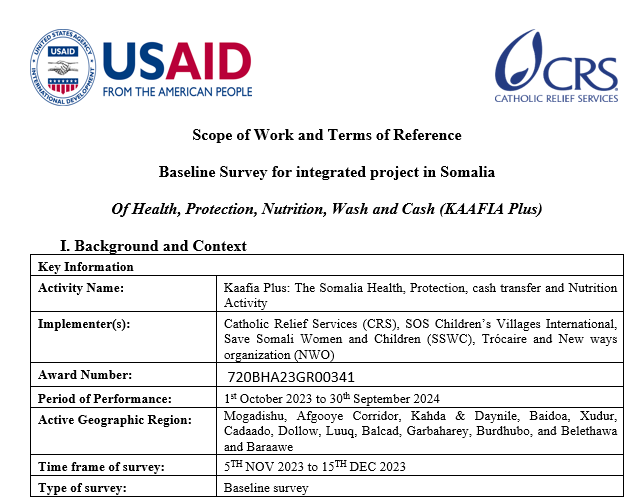
Through 12-month Kaafia Plus activity, CRS, and consortium partners New Ways Organization (NWO), Save Somali Women and Children (SSWC), SOS Children’s Villages Somalia (SOS) and Trócaire Somalia will integrate health, nutrition, protection, WASH and multipurpose cash assistance (MPCA) interventions to support an estimated 625,503 internally displaced persons (IDPs) and host communities in Gedo, Bay, Bakool, Banadir, Middle Shabelle, Lower Shabelle, and Galguduud Regions. Building upon successes from previous SHARPEN activities, Kaafia Plus will advance gender-responsive and safe programming across sectors, mitigate the risk of gender-based violence (GBV) and support GBV survivors and ensure that people with disabilities, youth and older people have equitable and safe access to health, nutrition and WASH services and products.
Kaafia Plus will advance community access to essential health services while strengthening local health systems. SOS and Trócaire will support 8 existing static facilities and 8 mobile medical units (MMUs), extending quality service provision to IDP camps with high numbers of recent arrivals, improving the capacity of healthcare providers to reach hard-to-access and newly displaced populations, respond to disease outbreaks and strengthening referral systems among facilities, ensuring regular delivery of necessary medical supplies and pharmaceutical commodities, and increasing the knowledge and understanding of households to seek care in a timely manner. These services will be fully integrated into the Somalia Ministry of Health (SMoH) health system but managed through NGO partners.
Kaafia Plus will support reduction of acute watery diarrhea (AWD) and cholera by increasing access to clean water and safe sanitation; improving hygiene practices and access to hygiene products; and increasing community engagement in waste management. Kaafia Plus will improve maternal, newborn, infant and young child nutrition (MIYCN) by enhancing caregiver knowledge of key nutrition practices; providing a full package of services to manage malnutrition; and integrating community messaging and education with the WASH sector to increase knowledge and ensure that communities connect good hygiene practices with improved nutrition. The WASH sector will support health and nutrition outcomes by extending access to clean water, effective hygiene promotion and safe sanitation to protect privacy, safety and accessibility to people with disabilities and older people.
The MPCA sector complements the other sectors. Kaafia Plus will provide households with unconditional cash transfers so that they can purchase food and other basic items and services that will also contribute to improving their health and nutrition status, while health and nutrition commodities will be provided free of charge. All sectors will incorporate protection principles to keep all participants safe from harm.
Kaafia Plus will enhance the protective environment for women and girls against GBV and improve their ability to recover from GBV incidents, expand access to comprehensive, high quality and safe services for GBV survivors and support legal actors to adopt a survivor-centered approach; legal actors in this instance refer to councils of elders who resolve cases informally as well as any legal representatives of NGOs and civil society who work in the protection sector on behalf of humanitarian service providers; these legal representatives may or may not be lawyers depending on their personal qualifications,. Male and female Community Champions will be engaged to promote positive social and gender norms with the aim of preventing GBV and community members will have improved understanding of the rights of women and girls to be free from GBV and women will be empowered to advocate for their rights.
KAAFIA Plus target objectives per sector are:
Kaafia Plus will advance the goal of improving the welfare of crisis-impacted Somalis through the following interrelated purposes and sub-purposes.
Purpose 1: Health status of target populations is improved.
· Sub-purpose 1.1: Static facilities and MMUs are resourced and function as part of the wider health system.
· Sub-purpose 1.2 Quality essential health services are available and accessible.
· Sub-purpose 1.3 Healthy behaviors, including timely and appropriate care-seeking of essential health services (EHS), are practiced by the target populations.
Purpose 2: Nutritional status of CU5 and PLWs improved.
· Sub-purpose 2.1 Nutrition behaviors among PLWs and CU5s improved.
· Sub-purpose 2.2 Malnourished CU5 and PLWs access comprehensive IMAM services.
Purpose 3: Incidence of AWD/Cholera in target communities reduced.
· Sub-purpose 3.1 WASH infrastructure and management strengthened.
· Sub-purpose 3.2 Good WASH practices increased.
Purpose 4: Protection of vulnerable women and girls from GBV is enhanced.
· Sub-purpose 4.1 Positive social and gender norms are practiced by IDP and host communities.
· Sub-purpose 4.2 Systems and services in support of GBV survivors strengthened.
Purpose 5: MPCA Sector: IDPs’ basic survival needs met.
a) CRS and Implementing Partners:
Catholic Relief Services currently addresses water, hygiene, sanitation, health, nutrition, and protection needs of vulnerable Somalis. CRS has been working closely with and channeling resources and support to local organizations in Somalia since the 1960s and has implemented activities in Mogadishu since 2011, in Baidoa since 2012, and in Gedo region since 2014. CRS builds on its global experience implementing high-quality humanitarian programming and its strong experience in South- Central Somalia. CRS provides overall management and technical direction to the activity, ensuring strong coordination, integration, and compliance.
SOS Children’s Villages International - An independent, non-governmental international development organization, working in Somalia since 1983. The SOS School was converted into an emergency clinic during the war, and the mother and child clinic became part of emergency relief programming. More recently, the SOS Vocational Training Center was established, which offers training courses for nurses and midwives. SOS has been working with CRS since 2011 on emergency programs to provide livelihood recovery, basic health, and nutrition services to vulnerable IDPs and host communities.
Save Somali Women and Children (SSWC) was founded in 1992 by a group of Somali female intellectuals from a cross section of the community and has a longstanding history of promoting women’s rights and advocacy. SSWC has worked in the areas of protection, WASH, and livelihoods, and prioritizes supporting grassroots economic projects for women, enhancing their capacity for advocacy on the issue of Female Genital Mutilation (FGM), providing training to Non-Governmental Organizations (NGOs) and Community Based Organizations (CBOs) on women’s rights, and raising awareness on the conditions of women and girls in Somalia in Baidoa, Mogadishu, Afgooye, Caadado, Dusamareeb and Kismayu. SSWC has been working with CRS since 2011.
Trócaire – Trócaire is an international non-governmental organization that works with local partners to support communities with a focus on food and resource rights, women's empowerment, and humanitarian response. Trócaire has been operational in Somalia since 1992 and is one of the few organizations that continued to provide life-saving interventions without pause throughout the chaotic decades of civil war. Trócaire employs a unique, community-led approach through all its work that has ensured access and safety for its staff and operations. Trócaire has been working with CRS since 2018.
New Ways Organization – New Ways Organization was established in 1993 and is one of the most established NGOs in Lower Shabelle. Baraawe In Baraawe district, NWO is implementing integrated health, nutrition, protection, and WASH interventions, including operating a safe house and providing essential services to GBV survivors. NWO has the infrastructure and community acceptance to provide on-site and outreach services in hard-to-reach areas. NWO has been a regular recipient of funding from UNICEF and other UN agencies to implement programs in Lower Shabelle, Bay and Galguduud. NWO is a member of the Strategic Advisory Group of Somalia and the co-chair of the Somalia Nutrition Sub-Cluster for the Bay and Lower Shabelle regions.
II. Purpose of the Baseline Survey
The purpose of the baseline survey is to establish baseline values for all outcome indicators, which will enable the team to set realistic Targets based on the budget, timelines of the project. In addition, the baseline will generate contextual data to help inform work planning and activity strategies. Below are the two main objectives of the baseline survey:
1. To establish baseline values for BHA’s approved performance outcome indicators, validate project targets, and provide crucial contextual information on the prevailing condition of the communities and populations supported by the proposed intervention.
2. To find out physical, social, and cultural barriers to accessing humanitarian services by IDPs and host communities in the target project locations.
Skills and qualifications
VII. ETHICAL CONSIDERATIONS INTELLECTUAL PROPERTY AND DATA PROTECTION
The below ethical considerations will be adhered to during the baseline survey process:
i.) The Baseline survey will be conducted by an independent and impartial external evaluator.
ii.) Participation in the survey will be voluntary.
iii.) The consultant and data collectors must sign and adhere to the CRS Code of Conduct
iv.) Anonymity, confidentiality, and safeguarding of survey data will be guaranteed.
v.) There will be no risks and benefits for individual participants.
vi.) The culture, norms and traditions of study populations will be respected.
vii.) Consent will be sought prior to commencing data gathering.
viii.) Views and Opinions of the different survey subjects will be respected.
ix.) Abide by the “Do No Harm” principle.
x.) Comply with USAID evaluation procedures by ensuring external consultant has been listed under Section 1.4.b.2.B of your award entitled "Sub-Award, Transfer, or Contracting Out of Any Work.”
xi.) CRS has ownership of all data collected during this survey.
xii.) Data collected using paper-based tools are kept by CRS in a secure location to be accessed only by authorized persons. Electronic data is stored on cloud-based servers which vary depending on the software used for collection: CommCare, Kobo Collect and PowerBI dashboards. Data collected on these platforms can be accessed by the authorized Head of Programs, MEAL Manager and PM.
xiii.) Data will be used primarily for CRS baseline survey and future reference. Only findings from analysis will be shared with the project partners, donor, and stakeholders. Raw datasets requested should be approved following CRS data protection approval processes.
IX. People Responsible
The survey is expected to be conducted by two experts: a lead evaluator and assistant evaluator who will oversee the execution of the entire survey process in partnership with CRS and partner staffs. The MEAL Manager will lead the overall coordination of the survey, checking quality and compliance issues to the CRS and USAID/BHA baseline guidelines. The evaluator will work with support from identified and trained enumerators for data collection. Clear roles and responsibilities are outlined in the table below.
Attachments
How to apply
Applicants when applying should submit a brief (maximum 3 pages) approach paper outlining how they understand the TOR and proposed methodology. In addition, applicants should submit their profile highlighting key areas of expertise and experience matching the required skills specified in these terms of reference. We also request links to at least three recent examples of relevant work, and the contact details for three references.
CRS will expect the following costs to be included in the consultant’s rate as appropriate and applicable: fees for translators, data collectors, data processors (as needed), logistics of survey teams, secretarial services, etc. CRS will provide consultant services based on a competitive bidding process and ability to complete the assignment within the proposed timelines. Indicative budgets should be prepared in line with the expected deliverables and should show all related costs including travel costs and anticipated overhead costs.
Full applications should be submitted electronically to: [email protected] with the subject line “CONSULTANCY SERVICES FOR KAAFIA PLUS BASELINE EVALUATION - SOMALIA”.
The deadline for applications is 22nd Oct 2023 by 5.00pm
Note: CRS does not charge any fees from applicants. Further, CRS has not retained any agent in connection with this request for proposal.