

 Facebook
 Twitter(X)
 LinkedIn
 Whatsapp
 Telegram
Job description
Terms of Reference for Situation of Young People Leaving Care in Somaliland
1. Introduction
SOS Somaliland is a Non-Governmental Organization (NGO) that is not for profit, non-sectarian and non-partisan and which has been in existence since 1999. SOS Children’s Villages in Somaliland beliefs that every child belongs to a family and grows with love, respect and security. To realize this, SOS Children’s Villages in Somaliland builds families for children in need, help them shape their own futures and share in the development of their communities.
The 2019 UN Resolution on the Rights of the Child (hereafter the Resolution) directly urges States Parties to ensure special protection and assistance to adolescents and young people leaving alternative care in preparation for their transition to independent living. This includes support in gaining access to education, training, employment, housing and psychological support, reintegration with their families when that is in their best interest and gaining access to aftercare services. In line with the recommendations from the Committee on the Rights of the Child (CRC), this partnership engagement promotes young care leavers’ right to mental health and sexual reproductive health, decent livelihood and active participation.
SOS Children’s Villages in Somaliland is implementing ‘Leave No Youth behind’ project. The overall objective of the project is - young people in Somaliland to be resilient and self-reliant to become independent and contributing members of society with a special focus on youth leaving care YLC. This project is to contribute to the realization of a better society where young people are self-reliant and depend on their own powers, resources and abilities to meet their needs and manage their own affairs. The project also aspires to make young people resilient to adversities/challenges in life and capable to withstand and recover quickly from difficult conditions.
The project will address the problems of discrimination, marginalization and stigmatization of young people aged 15–25 who grow up without parental care. Whether they have been placed in residential care facilities, in foster care or other types of care, they are at high-risk suffering from a variety of challenges including poor social networks, mental health problems, un-employment and homelessness. Cultural and gendered norms give young women and men different vulnerabilities as they grow out of care and transition to independent living. Young women are at high risk of gender-based violence, trafficking, early pregnancies and early marriage, and school drop-out while young men are at risk of ending up in hazardous work, living on the streets and in conflict with the law. Consequently, they risk exacerbating intergenerational poverty, and intensifies the risk for young care leavers to be either the drivers of conflict or the victims of conflict. The context of complex crisis compels sensitivity to the humanitarian, development and peacebuilding nexus in order to contribute to the sustainability of programme outcomes and longer-term resilience and rehabilitation of the communities where we plan to intervene.
In addition, even though the government of Somaliland has enacted policies and guidelines through the various agencies and ministries such as the national youth policy, employment policy, the national development plan two, sector development plan 2022 to 2026 of the Ministry of Employment and Family Affairs, Child policy, national alternative care guidelines (still a draft); finalization and implementation of such policies and guidelines is very minimal. Besides, there are no limited focus on young people who have left care. The government of Somaliland has put in place efforts to address the holistic issues of that affect young people as a vulnerable group i.e unemployment, education access among others. It was found that, there is no specific focus or arrangement to target young people who are in care or have left care in Somaliland.
The project focuses on 3 major outcomes with their relevant outputs to achieve the above stated goal and focuses on human rights-based approaches and targets duty bearers to demonstrate capacity and commitment to fulfil their responsibility to respect, promote and realise the rights of youth, and Rights Holders (youth leaving care) to have the capacity to exercise and claim their rights, hold duty bearers accountable and understand their corresponding entitlements in relation to specific duty-bearer.
In summary, the project aims to achieve the following outcomes:
Outcome 1: Policy Environment: Decision makers put policies/laws in place that strengthen the support for YLC.
Outcome 2: Strengthening Duty Bearers: Social protection systems respond to the needs and rights of young care leavers on their journey to independent living
Outcome 3: Empowering Right Holders:
To produce evidences, the project is initiating Research on the situation of young people leaving care in Somaliland (all 6 regions) to provide insights and recommendations on the challenges faced by young people leaving care. This research will add to the scant literature and body of information about young people leaving (Residential care centers and other forms of alternative care) in Somaliland and hopefully be a benchmark for both national and international efforts for improving the process of family and social integration of young people leaving care. The study contributes to the first outcome of the project, which is strengthen the support of YLC through analyzing, improving and advocating the existing policies (alternative care policy & youth policy), and developing contextualized guidelines (gatekeeping guidelines, foster care guideline- and minimum standards of care).
2. Aim & Objective of the research
Objective research:
The aim of the study is to assess the situation of young people leaving care in Somaliland. This entails mapping out the opportunities, challenges and threats that young people leaving in Somaliland are facing. Based on the study findings, the research will provide recommendations to address the barriers, take advantage of the opportunities, and avoid the threats that youth leaving care face during/after the transition period (leaving residential care centers and other forms of alternative care settings).
Specific Objectives:
- To assess the level of social integration of youth leaving care (leaving residential care centers and other forms of alternative care settings) in Somaliland.
- To assess the overall situation (challenges, opportunities and threats) of young people leaving care in Somaliland prior to/during the transition period.
- To analyse the root causes of the challenges and barriers including cultural norms and social integration.
- To examine the level of support (from government, CSO and community) youth care leavers reaceive during the transition period.
3. Research Question(s)
- What are the challenges young people leaving care in Somaliland face during the transition period (leaving residential care centres and other forms of alternative care settings)?
- What are the root causes of the challenges faced by young people leaving care?
- What opportunities are available for young people leaving care in Somaliland during the transition period (leaving residential care centres and other forms of alternative care settings)?
- What is the overall level of social integration of youth leaving care (leaving residential care centres and other forms of alternative care settings) in Somaliland.
- What are the recommended solutions for the challenges in the different aspects affecting the lives of the children and young people living or leaving alternative care settings?
5. Methodology & scope5.1 Study Area
The study will be conducted in all the regions of Somaliland (Maroodi-jeeh, Togdheer, Awdal and Sanaag).
5.2 Study population
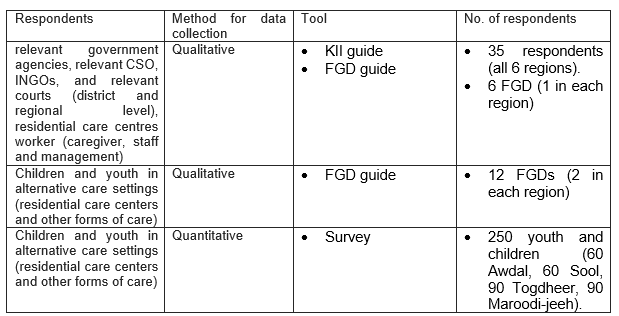
The study population include children in care setting, youth leaving care, residential care centres worker (caregiver, staff and management), other forms of care caregivers, relevant government agencies, relevant CSO, INGOs, and relevant courts (district and regional level).
5.3 Methodology
The consultant is expected to propose an appropriate study design involving both qualitative and quantitative data collection and entailing beneficiary survey, document review, focus group discussions and key informant interviews.
The consultant will be required to conduct research with a great level of collaboration and regular update with SOS CV Somaliland team as well as Ministry of Employment, social affairs and family’s technical team.
6. Deliverables
The study as result will produce a concise research report, in English with a maximum length of 30 pages including an Executive Summary. All confidential information must be kept in a separate annex to protect participants. The final report will be provided electronically and in hard copy.
The report format below must be strictly adhered to:
- Cover page
- Title of study
- Country, Project, date of study and study locations
- Name of consultant
- Executive summary (maximum 2 pages; cross-reference pages or paragraphs in the main body)
- Evaluated action
- Purpose and methodology (incl. limitations and challenges)
- Main conclusions, recommendations, and lessons learned
- Main body
- The structure of the main body is determined by the desired results
- For each key conclusion, there should be a corresponding recommendation that is realistic, pragmatic, and operational
- Annexes
- Terms of Reference
- List of persons interviewed and sites visited
- Map of areas covered by the study.
- Raw data in SPSS/Excel
- Data collection tools
The study will be carried out in 3 stages. All steps that lead to deliverables are marked in bold.
Stage 1: Prepare
Undertake all required preparations for the field work: propose detailed methodology, conduct desk research, identify key informants, plan data collection process, organization & logistics, and prepare field visit schedule.
- Submit and secure approval for the refined study design and methodology in an inception report document:
- proposed methodological set-up,
- locally adapted and proposed data collection tools. Preparation of checklists, participant lists and other management/organisational information for data collection.
- Training enumerators with PPT approved by SOS Children’s Villages in Somaliland.
- Pilot testing of the data collection tools.
Stage 2: Conduct
- Facilitate learning during the data collection exercise.
- Collection of data as per the agreed methodology and tools.
- Analysis of the data.
Stage 3: Submit findings
- Preparation of a draft report in English
- Presentation of the findings to the Project staff / national office staff /
- After having received feedback from the various stakeholders – finalise the report and submit it in English [and other language if needed].
7. Timeline
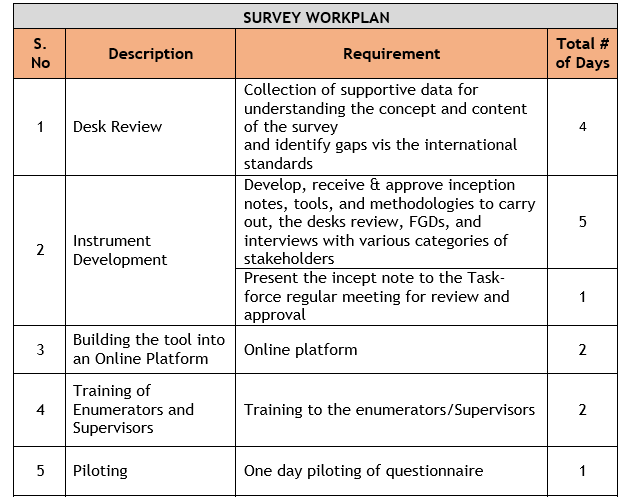
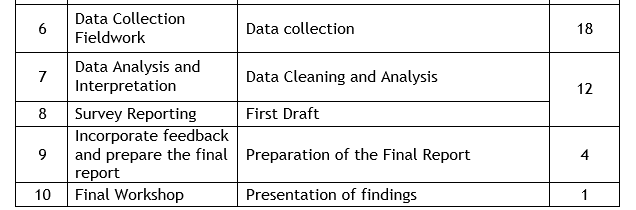
The research is expected to be concluded in 50 working days, which can be broken-down as follows:

Skills and qualifications
The researcher/ team of researchers are expected to have:
- Advanced degree in social research methods, population development or social science (e.g., statistics)
- Prior experience working on research specific human rights, child rights, children in alternative care.
- Prior experience working with youth and children.
- A minimum of 5 years of experience in conducting quantitative and qualitative research
- Knowledge of gender-sensitive approaches
- Excellent communications skills in English, including advanced writing skills
- Strong communication skills in Somali and English.
- Direct experience working with children both boys and girls in Somali settings.
- Experience in qualitative research will be an added advantage
9. Key reference materials
The interested applicants should be familiar with the following documents:
- UN convention on the rights of children.
- UN guidelines for alternative care for children.
- Somaliland alternative care policy.
- Somaliland youth policy.
Attachments
How to apply
.To facilitate the submission of proposals, the submission can be done electronically in PDF format and sent to SOS HR Department via to [email protected] on 16-Nov-2022.
The titles of the submitted document should clearly state in block letter for further information and inquiries please email [email protected] before 13-Nov2022.
..................................................
NAGUSOO BIIR --- SOMALI JOBS
Telegram: https://t.me/somalijobsinc
Linkedin: https://www.linkedin.com/company/somali-jobs/
Facebook: https://www.facebook.com/somalijobs
Facebook Group: https://www.facebook.com/groups/somalijobs
Twitter: https://twitter.com/somalijobs
Instagram: https://www.instagram.com/somalijobs/
Application: https://play.google.com/store/apps/details?id=com.tiriig.somalijobs
Tiktok: https://www.tiktok.com/@somalijobsinc
Youtube: https://www.youtube.com/channel/UCterdvGtdVbUNKQiZFCLenw
.................................................