


 Facebook
 Twitter(X)
 LinkedIn
 Whatsapp
 Telegram
Job description
Terms of Reference
Developing Community- based child protection guideline
BACKGROUND
SOS Children’s Villages is a global federation of 136 national SOS Children’s Villages associations, working in more than 2000 project locations worldwide. We work together with a single vision: every child belongs to a family and grows with love, respect and security.
SOS Children’s Villages is committed to the welfare of children who lost parental care or at risk of losing parental care – often ensuring that children grow up in a loving family environment, and to strengthening families and communities as a preventive measure in the fight against child abandonment and social neglect, and upholds child protection policy as part of their commitment to the protection of children and youth from abuse.
SOS Children’s Villages in Somaliland (SOS CV) is a part of SOS Children’s Villages International, the umbrella organization to which all SOS Children’s Villages including SOS Children’s Villages in Somaliland Association is affiliated. SOS CV is a Non-Governmental Organization (NGO) that is not for profit, non-sectarian and non-partisan and which has been in existence since 1999. SOS Children’s Villages in Somaliland shares vision with SOS CV International and beliefs that every child belongs to a family and grows with love, respect and security. To realize this, SOS Children’s Villages in Somaliland builds families for children in need, help them shape their own futures and share in the development of their communities.
Family strengthening programme:
The Family Strengthening Program enables children who are at risk of losing the care of their family to grow within a caring family environment. To achieve this, SOS Children’s Villages works directly with families and communities to empower them to effectively protect and care for their children. In line with SOS’s Family Strengthening program (FSP) strategy is to build the capacity of the community-based partners to develop sustainable and relevant responses to reduce the risk of children losing parental care in the project area.
Introduction of the Activity:
Child protection is of relevance to all children and not just the children considered at high risk of rights violations or who live in vulnerable situations, although they may have particular protection requirements. As a result, child protection is the responsibility of society as a whole and involves a range of groups. To be successful, child protection strategies and approaches require the involvement of communities, families, parents/guardians, teachers, traditional and religious leaders, elected
representatives and government authorities.
Community based child protection mechanisms (CBCPMs) are generally “a network or group of individuals at community level who work in a coordinated manner towards protection of children from all forms of violence, exploitation abuse and neglect in all settings.
Such mechanisms can be indigenous or externally initiated and supported. They may be more formal or informal in their structure and functioning. CBCPMs are linked and contribute to the wider child protection systems set-up by the primary duty bearers – normally the state and local as well as national Government.”
Communities play significant roles in preventing and responding to the risks children face in the communities. Communities organize themselves in a variety of ways to protect children. In displacement settings, community structures and networks may be disrupted or evolve due to significant and sudden changes. This may weaken their ability to protect children. Communities can also be a source of risk. Risks may come from the physical environment or from community members themselves.
CBCPMs are currently seen as one of the most effective and efficient ways to achieve the right to protection for children, as they are cost effective in nature if well rooted in the community systems
Aims of CBCPMS:
Increase community ownership of project interventions, building on existing resources, gain support from local leaders, promote child participation, ensure proper management of issues of power, diversity and inclusivity and promote linkages among stakeholders.
Community-based child protection systems are a vitally important part of an effective national response. Communities are where children live and where abuse happens. Communities contain structures including local authorities, schools, health centres, police, and civil society members that can be mobilised to keep children safe. Children should always be a part of the mobilisation process.
OBJECTIVES OF THE ASSIGNMENT
The main objective of this assignment is to develop a comprehensive and user-guide for community-based child protection guideline and implementation plan and provides a firm basis for effective response to child protection issues. It also aims to build the capacity of the Member Association (MA) staff, and their implementing partners to conduct activities following guidelines that are based on the guideline and establish baseline benchmark.
The community-based child protection guideline is intended to strengthen the following principal and values of child protection work:
Respect for children’s rights – Child protection is often described as unpinned by the right based approach. If the rights of children, for example, are provided for and protected,
Non-discrimination – Non-discrimination promotes the idea that every child has rights and is thus entitled to support without exception. Discrimination can be based on a range of factors, including but not limited to gender, race, ethnicity, political affiliations, religion or status as a refugee or internally displaced person.
Best interests of the child – All actions taken on behalf of children should be based on a
simple question – What is in their best interest? Sometimes, establishing the best
interest of the child can be challenging, and it is important not to see children as isolated individuals but as part of a family or community because it is possible that their best interest may be met by providing support to the family or community. Careful analysis is needed.
Respect for cultural values and positive endogenous practices – Generally speaking,
families and communities already have a range of strategies, mechanisms and practices for protecting children, and it is import to understand and not dismiss or overlook them when it comes to developing child protection strategies.
Participatory – Involve children, families and communities as social agents with the capacity to influence their situation in a positive way.
Approach children, families and communities with a focus on their competencies and
strengths – It is common to view marginalized groups, displaced communities or victims of abuse as damaged or lacking the ability to take care of themselves. However, the focus should not just be on people’s needs but also on any strengths, resources or
capacities that they have that could form the basis of protection activities and
programmes.
Focus on strengthening a sense of involvement in community life through the restoration of normal everyday routines and activities – Everybody has needs, and in general these are met through everyday structures, such as the support provided by families, friends and communities. For some reason, these may stop working or break down during crises, such as armed conflict, displacement or as a result of the threat of ongoing insecurity.
Integrate child protection into a range of activities – Child protection issues are complex, arise for a variety of reasons and are found across different settings. There is only so much that child protection actors can do; however, it is important to make others aware of protection concerns and how their own activities can either put children at risk or contribute to building a more protective environment. Child protection should be mainstreamed into the work of most sectors, including education, health care, justice, security and humanitarian response.
Base child protection activities and programmes on both an initial and ongoing need
assessment – It is important to use initial and ongoing need assessments to know the
causes and extent of child protection concerns and to thus make appropriate action
plans.
KEY DELIVERABLES
The consultant would be required to complete the following:
• Clearly outline the objective of the community-based child protection guideline and how it contributes to the program quality and the community welfare.
• Desk review of other organization’s policy documents, secondary literature, related to community-based child protection
• Mapping if there are any gaps in the community-based child protection systems in Somaliland.
• Structure of the guideline will include the following:
I. Introduction to child protection committees
II. Composition of the child protection committee
III. Formation of child protection committee
IV. Roles and responsibilities of child protection committees
V. Referral mechanism pathway through case management procedures.
VI. Monitoring and reporting mechanism
VII. Training and capacity building for child protection committees
VIII. Code of conduct and accountability mechanism
IX. Develop simple and understandable forms for reporting and referral incidents.
X. Sustainability for community-based child protection.
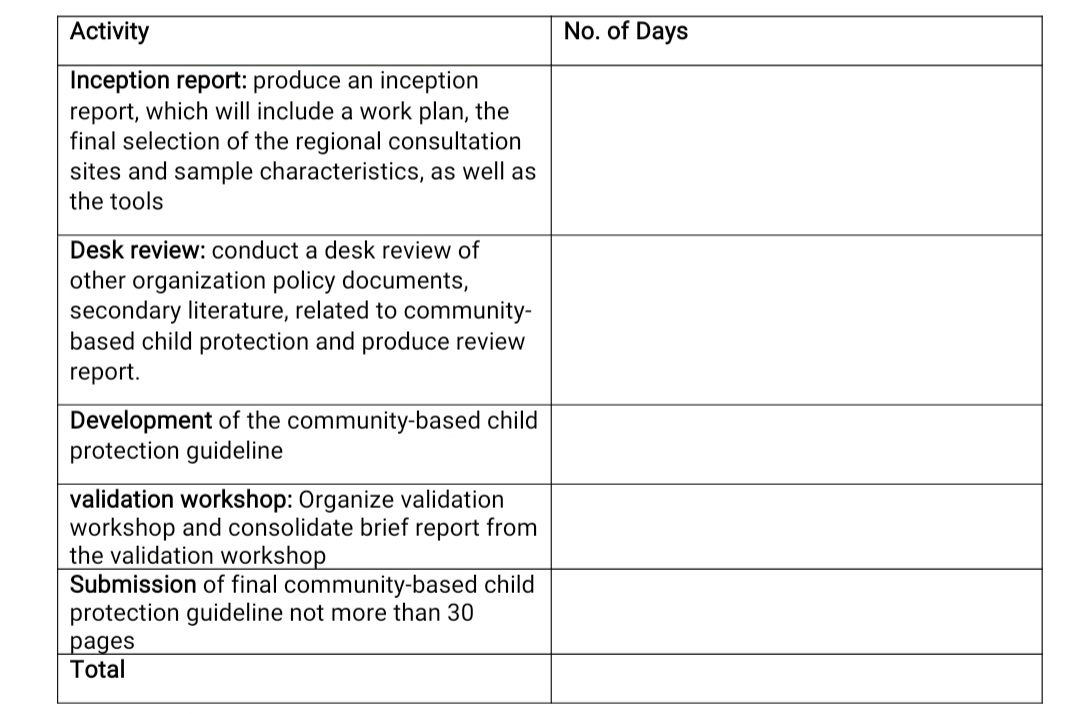
TIMELINE:
Deliverables and delivery dates (based on the work plan)
Reporting line
The consultant will report directly to SOS Children’s Villages family strengthening programme National coordinator
Skills and qualifications
GENERAL INFORMATION ON REQUEST FOR PROPOSALS
The bidders are welcome to submit their proposal of the community-based child protection guideline development for SOS Children’s Villages in Somaliland. This bid is open to all national and international suppliers (independent consultants or companies) who are legally constituted and can provide the requested services. The bidder shall bear all costs of the bid; costs of a proposal cannot be included as a direct cost of the assignment. The proposal and all supplementary documents must be submitted in English. The financial bid needs to be stated in USD.
Attachments
How to apply
Process of Submission of Bids
To facilitate the submission of proposals, the submission duly stamped and signed can be done electronically in PDF format and sent to [email protected] electronic submissions preferred.
The titles of submitted documents should clearly state “Proposal for development of SOS Children’ Villages in Somaliland the community-based child protection guideline” Please make sure that the technical and financial proposals are handed in separately (financial proposal to be submitted in a separate PDF file). During the process of evaluation, technical bids will be opened and evaluated first. The financial part of those proposals, which are shortlisted after evaluation of the technical proposal, will be opened in a second step.
Bid submission / identification form
• Previous experience format
• Price schedule form (to be sealed in a closed envelope or a separate PDF file)
• Technical proposal
• CVs of the research team member(s) including current geographical location(s)
• Three references (at least two of them must be familiar with your work)
• An example of a recent/relevant guideline developed (if available for public use)
Deadline for submission
The proposal must be received by latest on 24th May 2023 by the end of the day. Proposals received after the deadline will not be considered.
Modification and withdrawal of bids
Proposals may be withdrawn on written request prior to the closing date of this invitation. Any corrections or changes must be received prior to the closing date. Changes must be clearly stated in comparison with the original proposal. Failure to do so will be at bidder’s own risk and disadvantage.
Signing of the contract
SOS Children’s Villages in Somaliland will inform the successful bidder electronically and will send the contract form within 3 weeks after the closure of the bid submission deadline. The successful bidder shall sign and date the contract and return it to SOS Children’s Villages in Somaliland within seven calendar days of receipt of the contract. After the contract is signed by two parties, the successful bidder shall deliver the services in accordance with the delivery schedule outlined in the bid.
Rights of SOS Children’s Villages:
· Contact any or all references supplied by the bidder(s);
· Request additional supporting or supplementary data (from the bidder(s));
· Arrange interviews with the bidder(s);
· Reject any or all proposals submitted;
· Accept any proposals in whole or in part;
· Negotiate with the service provider(s) who has/have attained the best rating/ranking, i.e., the one(s) providing the overall best value proposal(s);
Evaluation of proposals
After the opening, each proposal will be assessed first on its technical quality and compliance and subsequently on its price. The proposal with the best overall value, composed of technical merit and price, will be considered for approval. The technical proposal is evaluated based on its responsiveness to the Term of Reference (TOR). Bidders may additionally be requested to provide additional information (virtual presentation or phone interview) to SOS Children’s Villages in Somaliland on the proposed services.